Transforming Real-Time Protection with Cloud-Delivered Security Services
Discover how unified prevention provides IT leaders with real-time protection across every attack surface.
The line between innovation and exposure has never been blurred in today’s hyperconnected digital world. Every new device, application and cloud workload expands the modern attack surface, creating endless opportunities for adversaries who are scaling faster and becoming more sophisticated than ever before. The threat landscape is no longer defined by isolated malware or phishing emails. The modern attack surface has evolved into a dynamic, adaptive ecosystem, driven by automation and artificial intelligence. Traditional security is no longer enough against AI-powered adversaries; protecting the modern attack surface demands a unified, intelligent Cloud-Delivered Security Services (CDSS) platform.
Attackers have learned to weaponize the same innovations that once gave defenders an advantage. Generative AI now enables them to craft convincing phishing messages, generate polymorphic malware that changes with every delivery, and automate reconnaissance at an unprecedented scale. Ransomware groups operate with the speed and agility of modern startups, using AI to identify weaknesses while staying one step ahead of detection. The result is an era where breaches unfold in minutes rather than days. Organizations are left with little room for error, underscoring the urgent need for security that goes beyond traditional approaches.
The Power of a Unified, Cloud-Delivered Security Service Platform
The power of our Cloud-Delivered Security Services lies in our ability to bring together every layer of protection into a single, intelligent, connected system. This unified platform combines Advanced Threat Prevention, Advanced WildFire® (AWF), Advanced DNS Security (ADNS) and Advanced URL Filtering (AURL) into a single AI-powered fabric that operates at the speed of the cloud.
Powered by Precision AI®, this framework delivers real-time contextual awareness across every stage of the attack lifecycle. It continuously analyzes billions of signals across networks, users and applications to transform raw data into actionable insights. This capability enables organizations to move from reactive detection to proactive prevention, stopping threats before they can disrupt operations.
Every day, our CDSS services analyze up to 5.43 billion new events, detect nearly 8.95 million never-before-seen attacks, and block up to 30.9 billion threats inline. This scale of visibility is strengthened by AI that’s trained on shared threat data from more than 70,000 customers, creating a powerful network effect that delivers patient-zero prevention everywhere. This depth of intelligence provides the visibility and context needed to understand and stop even the most sophisticated attacks as they evolve.
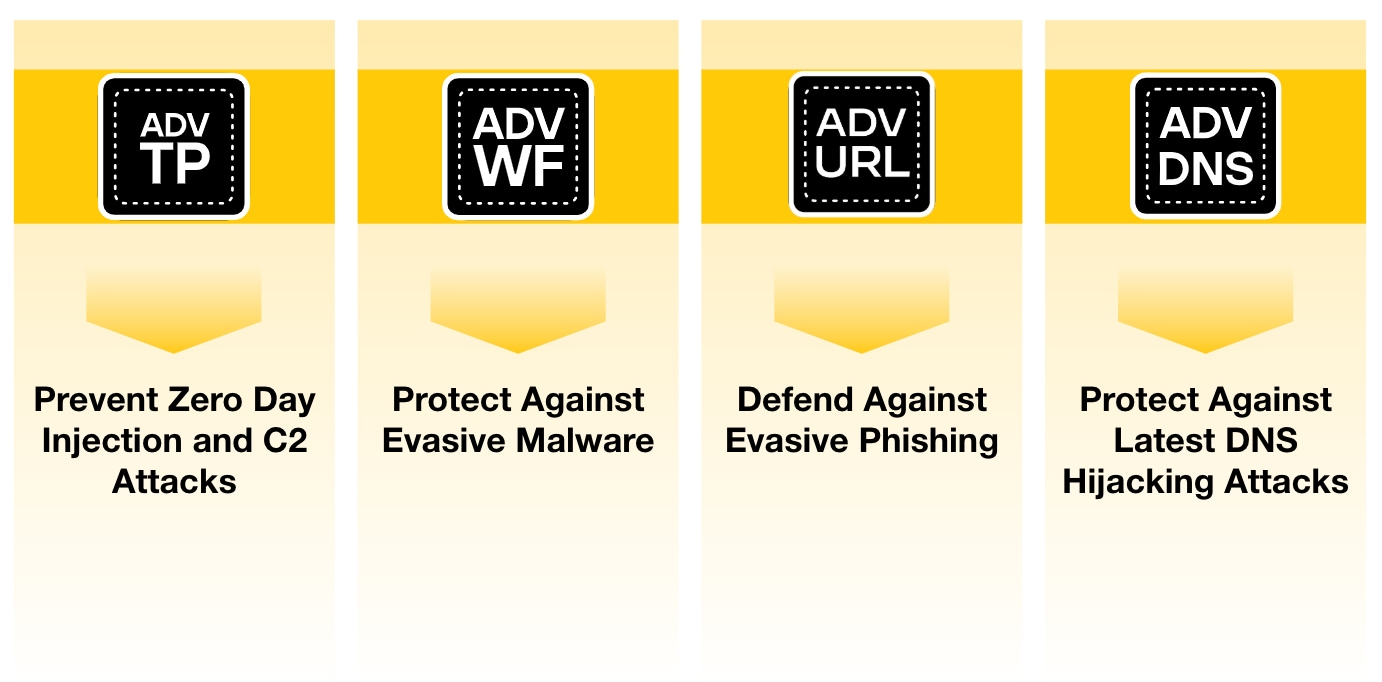
Shared telemetry flows naturally across services, helping ensure threats are detected and prevented without operating in silos. A phishing domain identified by Advanced DNS Security can immediately inform Advanced URL Filtering to block the malicious site. When Advanced WildFire uncovers a new zero-day technique or malicious artifact, that intelligence is shared instantly across the CDSS intelligence layer. Inline services, like Advanced Threat Prevention and Advanced URL Filtering, are enabled to strengthen protections in real time without manual intervention.
For IT leaders and security teams, this unified approach delivers comprehensive visibility and protection that keeps pace with their environment. Continuous intelligence adapts as conditions change, reducing complexity and improving operational efficiency. With consistent policy enforcement, faster decision-making and unified management across the enterprise, organizations can shift their focus from maintenance to innovation and growth.
The Moment Traditional Security Stopped Being Enough
There was a time when traditional network security was enough. Perimeter defenses and signature-based tools could reliably detect and block most threats before they caused harm. For years, this layered approach gave organizations a sense of confidence and control. But that moment has passed.
Our Unit 42® team has found that attacks are now faster, more sophisticated and more disruptive than ever, with 86% of major incidents in 2024 resulting in business disruption. This shift underscores how quickly traditional defenses are being outpaced and why yesterday’s security models no longer match today’s threat landscape.
Traditional, siloed architectures simply cannot keep up with modern attackers. What once served as a strong defense is now outmatched by adversaries who use AI to move faster and slip through the cracks of static security controls. Attackers no longer need to rely on predictable patterns or known exploits. They can use machine learning to probe defenses, mimic legitimate activity and disguise malicious activity within normal traffic, allowing them to bypass systems once they are considered unbreakable.
Older security products that depend on static signatures or manual policy updates cannot match this speed and scale. They respond to what has already happened, not to what is happening right now. By the time a new rule is written or a patch is applied, the threat has already evolved. Fragmented visibility and delayed response times give adversaries the upper hand, leaving IT teams defending blind against threats that adapt and shift faster than their defenses ever could.
In an effort to compensate, many organizations continue to add more tools: One for web filtering, one for DNS, one for malware analysis and one for data protection. While each solution provides value, they rarely work together. The result is an overcomplicated ecosystem of disconnected products that create visibility gaps, duplicate alerts, inconsistent policy enforcement and operational overhead. These gaps are exactly where attackers find their opportunity.
The moment traditional security stopped being enough was the moment attackers learned to think and move like machines. The rise of AI-powered threats marked the end of static defense and the beginning of a new kind of warfare, one that demands prevention and is predictive, adaptive and unified.
Today, enterprises don’t need more point products. They need a single, intelligent security fabric so they can see, understand and act across every vector, from DNS to SaaS to endpoint, in one coordinated motion. Attackers increasingly weaponize GenAI to craft more evasive phishing pages, malware and domain infrastructures. So, security teams must rely on defenses that can counter these techniques in real time by effectively battling AI with AI.
That is where cloud-delivered security services (CDSS) redefine the game, bringing AI-driven prevention to every corner of the network.
Your Defense Is Only as Strong as What’s Enabled
Having the proper security tools is only part of the equation. Real protection comes when those tools are fully enabled, integrated and working together to secure the organization. Cloud-delivered security services deliver their greatest value when they are live and continuously analyzing traffic, sharing intelligence and adapting in real time to support the business.
Too often, organizations have the right capabilities in place but leave them underutilized or inactive. Protection begins the moment each service is turned on and working in unison to deliver real-time prevention at scale. Ensuring that these capabilities are fully enabled and actively defending the network is what turns investment into impact.
Prevention is about readiness, not reaction. The most resilient organizations are those that activate early, integrate completely and allow automation to amplify what human oversight cannot. When IT leaders enable Advanced Threat Prevention, AWF, ADNS and AURL, prevention becomes continuous, intelligent and aligned with the pace of modern threats.
The power of our CDSS lies in both their advanced technology and the unity they create. Together, these services form an intelligent defense that connects detection, prevention and response into one seamless operation, all powered by Precision AI.
Now, with AI reshaping both innovation and risk, CDSS helps organizations stay confidently ahead. IT leaders who enable these capabilities strengthen visibility, simplify operations and elevate their overall security posture.
Fully enable your defenses and have them ready to prevent threats at each stage of the attack lifecycle. Learn more about activating CDSS through Strata™ Cloud manager or speak with your Palo Alto Networks representative to see how unified, AI-powered prevention can strengthen your organization’s security posture.
Key Takeaways
- Traditional Security Is Insufficient Against Modern Threats
The rise of AI and automation has created an era in which attackers move faster and are more sophisticated than traditional, siloed security products can handle, leading to an increasing number of major incidents that disrupt business. - Unified Cloud-Delivered Security Services (CDSS) Are Necessary for Proactive Prevention
Protecting the modern attack surface requires a single, intelligent, connected CDSS platform that unifies all layers of protection (e.g., Advanced Threat Prevention, AWF, ADNS, AURL) into an AI-powered fabric, enabling proactive, real-time prevention rather than reactive detection. - Real Protection Depends on Full Activation and Integration
Having the right security tools is only part of the solution. The greatest value and protection are realized when your fully enabled CDSS is integrated and working in unison to continuously analyze traffic and share intelligence.