At 4:15 PM on a Tuesday, emergency alerts highlighted two severe remote code execution vulnerabilities in the PHP runtime: CVE-2026-109618 and CVE-2026-109619, both scoring 9.2 on the CVSS scale. The first flaw allows attackers to execute code through uninitialized memory, while the second enables arbitrary code execution from dangling pointers. Crucially, these vulnerabilities reside in the PHP core itself, allowing unauthenticated remote code execution (RCE) before any application-level code ever executes.
With over 22.6 million exposed instances currently identified, chaos ensued as enterprises reacted; some governments even took web portals offline. This incident highlights the inefficiency of fragmented security tools in handling software vulnerabilities.
Read the full Unit 42 Threat Brief for technical details and recommended protections.
In response, organizations are turning to unified security architectures like Cortex XSIAM to integrate asset visibility, risk prioritization, and automated remediation, allowing for quicker threat neutralization before business operations are disrupted.
1. Asset Visibility: Mapping Code to Infrastructure
The first question during any major outbreak sounds deceptively simple: Where is this software actually running?
In multi-cloud environments running Kubernetes and serverless workloads, static inventories go stale in minutes. Security analysts waste valuable time juggling separate consoles—scanning cloud provider dashboards, checking container registries, and firing off external network probes.
Isolated tools create blind spots. External Attack Surface Management through tools like Cortex Xpanse flags unknown, internet-facing systems from the outside.
Cortex XDR and Cortex Network Scanner as part of Exposure Management, help to detect these vulnerabilities on managed and unmanaged assets across the customer environments.
Here, Cortex XSIAM, ASM, and Xpanse customers can review the Emerging Vulnerabilities information and ensure that related Attack Surface Rules are enabled in their environments.
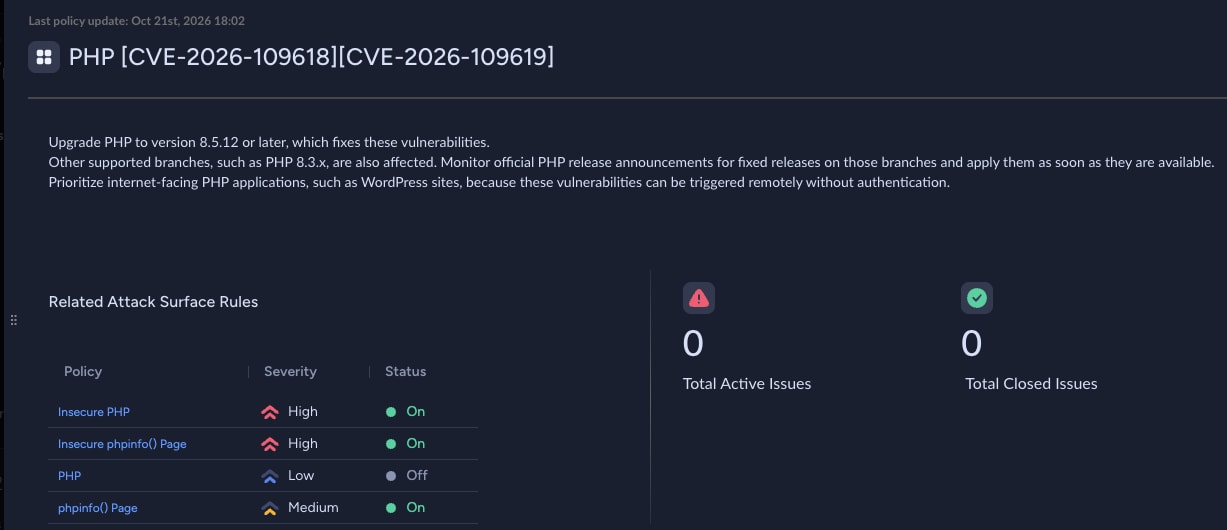
Comprehensive asset discovery must account for diverse deployment setups across the enterprise. Affected configurations include server environments utilizing PHP-FPM, Apache web servers running mod_php, traditional php-cgi setups, high-performance web servers like FrankenPHP, and LiteSpeed instances. Furthermore, containerized environments and automated CI/CD pipeline build runners hosting PHP runtimes face significant exposure if left unmapped.
The Platform Approach: Merging external exposure data with internal container telemetry into Cortex XSIAM gives security teams an immediate, precise asset graph across their entire fleet without manual digging.
2. Prioritization: Cutting Through Alert Fatigue
Finding every instance triggers the next hurdle: alert fatigue. A raw vulnerability sweep across a global footprint might return 5,000 PHP matches.
Treating every match as an emergency grinds work to a halt. Dumping thousands of critical tickets on developers destroys trust, while emergency patches carry real risks of breaking production services.
This is where standard vulnerability management breaks down. Exposure Management in Cortex XSIAM evaluates true risk across five distinct vectors:
- Network Exposure: A vulnerable PHP runtime on an open web server requires instant action. The same binary isolated inside a private subnet behind strict access rules presents minimal immediate threat.
- Security Controls: Are your Firewalls and endpoints already mitigating the risk? You can use Security Controls to filter the assets where protection is not in place or it's not effective to focus on where the real risks are.
- Vulnerability and Exposure management: Are your assets exposed to PHP vulnerabilities and currently at risk
- Active Threats: Real-time threat feeds show whether adversaries are actively exploiting specific endpoints in the wild.
- Business Criticality: Mapping workloads directly to core services ensures production payment gateways take priority over internal staging environments.
Filtering raw telemetry through these filters strips away noise, giving engineering teams a focused, actionable remediation list containing only exposed, high-risk attack paths.
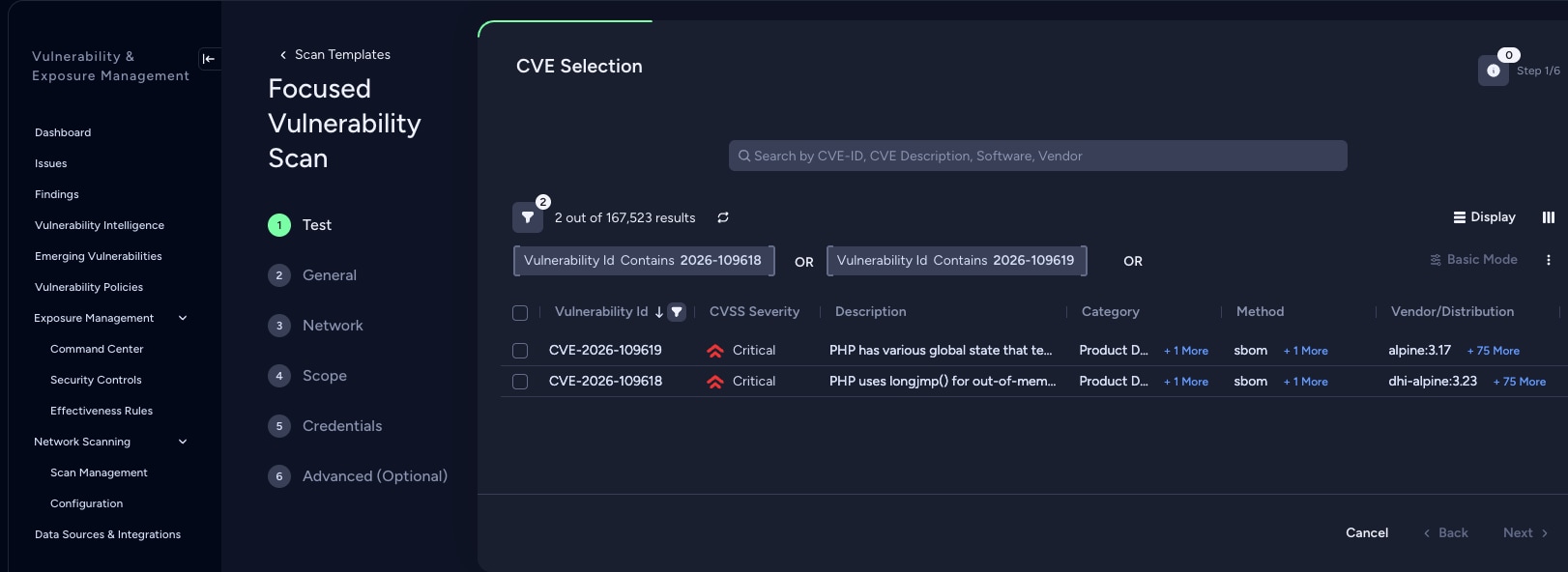
Cortex XDR and Cortex Network Scanner expand vulnerability detection coverage for Cortex Exposure Management customers. This helps identify vulnerabilities across managed and unmanaged assets scanned by Network Scanner, including through credentialed scans. The Focused Vulnerability Scan also lets you quickly scan your environment for this specific vulnerability.
3. Remediation: Automated Defense and Mitigation
Scoping and prioritizing vulnerabilities solves the analysis problem, but fixing them quickly remains the main hurdle.
Attacking scripts scan target networks instantly. Traditional patching—writing code, opening pull requests, running integration tests, and deploying updates—takes days. Security teams need automated boundary protections and streamlined workflows to bridge that gap.
An integrated platform handles response velocity in two key ways:
- Automated Orchestration: Cortex XSIAM playbooks dispatch enriched incident reports to engineering teams instantly, generating tickets pre-filled with container image tags and repository links.
- Inline Virtual Patching: While vendor patches undergo testing, perimeter tools hold the line. Advanced Threat Prevention features enforce threat signatures (like Threat ID 543004) across network gateways, blocking malformed HTTP requests before they reach vulnerable PHP instances.
- Threat Hunting & Investigation Vectors: Security teams should actively search for indicators of compromise (IOCs), such as suspicious spawned child processes under PHP runtimes, unexpected interactive shell executions, creation of unverified new PHP files within web directories, and abnormal worker process crashes indicative of exploit attempts.
Moving Beyond Crisis Management
Critical runtime flaws like CVE-2026-109618 and CVE-2026-109619 are part of running modern software. The operational chaos that follows them doesn't have to be.
By replacing fragmented point products with an integrated platform like Cortex XSIAM, which combines asset visibility, exposure-based risk scoring, and automated mitigation, organizations can turn emergency fire drills into routine, manageable operations.
Legacy Infrastructure Warnings: Organizations maintaining legacy infrastructure running PHP 8.1 or older require immediate intervention. Because these end-of-life versions may not receive official upstream patches, security teams must enforce strict network isolation, apply custom backported patches, or leverage virtual patching to prevent exploitation.