Email is the original digital currency of business. It’s also cybersecurity’s longest-running comedy, and unfortunately, its most persistent tragedy.
For over two decades, attackers have played a relentless game of cat-and-mouse, constantly evolving their tactics. But where they once relied on human error, they now lean on artificial intelligence.
This isn’t just a story about security; it’s a history lesson on the changing nature of trust. So, dim the lights, put on your documentary voice, and let’s rewind the tape on the evolution of email threats.
2000: The Age of Innocence – When Curiosity Killed the Inbox
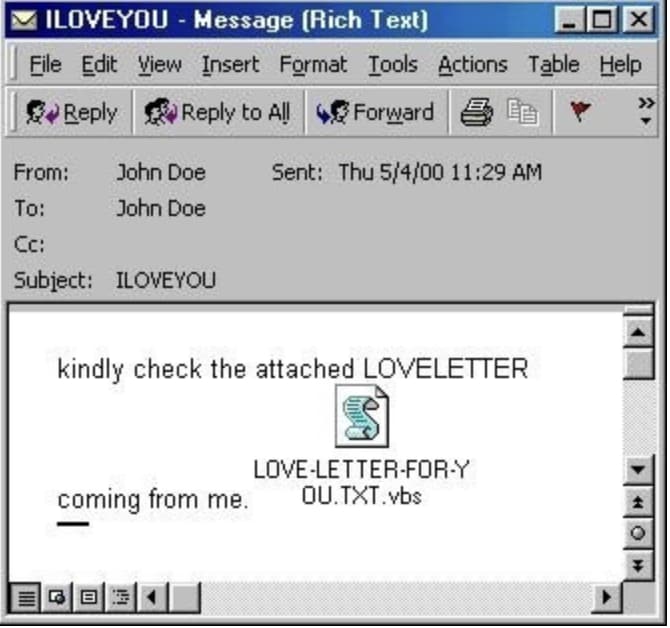
Our journey begins at the dawn of the millennium with a phrase that brought the world’s digital infrastructure to its knees: “ILOVEYOU.”
This was the Wild West of email. When a catchy subject line and a mysterious attachment (disguised as a love letter, no less) landed in your inbox, curiosity was the primary vulnerability. They clicked because, well, what’s the harm in a simple email?
The attacks were simplistic: mass-mailed, often poorly coded, and purely focused on delivering a malicious payload (the world’s first widely successful malware distributed via email). Defenses were equally simple: essentially, spam filters that looked for known bad file types or exact signatures. It was primitive, but it worked until the next shiny new threat arrived.
2015: Mass Spam Goes Corporate
By 2010, the gold rush was on. Attackers realized that while malware was fun, cold, hard cash was better. This decade saw the rise of the spam armies, vast botnets slinging billions of emails promising everything from discounted medication to unimaginable wealth from a distant, deposed prince.
This era was defined by volume. You didn’t need clever language; you just needed to hit enough mailboxes. Traditional Secure Email Gateways (SEGs) were born and evolved rapidly to combat this flood. They focused on perimeter defense, using blocklists, sender reputation, and keyword matching.
The defenses were strong, but the attack model had a flaw: the scams were often laughably bad. Grammatical errors, bizarre formatting, and the sheer implausibility of the Nigerian Prince story were the security team’s best friends. The scammers hadn't yet learned to write like real people.
2015: Spear Phishing Goes Corporate
Then, the attackers grew up. They realized that sending a million terrible emails was less profitable than sending one perfectly crafted email to the right person.
This shift marked the rise of spear phishing. The threat moved away from malware attachments to social engineering and financial fraud. Attackers targeted CFOs, HR staff, and executives with messages that were clean, payload-free, and based on simple deception: "Hey, I need you to wire this money now," or "I've updated my payroll information."
Traditional email security fell flat here. Since there were no malicious links, no file attachments, and no red-flag keywords, the legacy systems simply let them pass. Email security had become a game of spotting the intent, not just the content. And isolated security tools lacked the context to win.
2024: The Perfect Phishing Email
Today, the challenge has multiplied for traditional security. The attackers have received the ultimate upgrade: generative AI (GenAI) and large language models (LLMs).
The old tell-tale signs of a scam, the bad grammar, the weird phrasing, are gone. AI writes flawless, context-aware, and hyper-personalized phishing emails at a scale and speed no human could ever match. Attackers can now mimic the precise tone of your CEO, reference a recent company event, and demand immediate action, all while bypassing every signature and rule-based filter imaginable.
This is the new existential challenge: AI vs. human vulnerability. The attack isn’t just on the email; it’s on the endpoint, the identity, and the network simultaneously.
The New Mindset: Fighting AI with Advanced Email Security
If the attacker is using the full power of AI, your defense must, too. Email security can no longer be a standalone tool, a single net dropped into a single stream. It must be a fully integrated, intelligent platform that sees the entire attack story.
This is where Cortex Advanced Email Security steps in. We deliver a fundamentally different approach that integrates email protection into the full power of the Cortex platform.
1. Understand True Intent with AI
We use LLMs, behavioral analytics, and user profiling not just to scan text, but to understand the underlying intent of a communication. Is this message from your CEO, or is it an attacker using AI to perfectly impersonate them? Cortex Advanced Email Security analyzes the context, the urgency, and the historical communication patterns to spot the deception that clean content easily hides.
2. Accelerate Response with Cross-Domain Data
A phishing email is just step one. After the click, the attack moves to identity theft, endpoint compromise, and lateral movement. Traditional solutions go blind the second the attack leaves the inbox.
Cortex Advanced Email Security breaks security silos by correlating data from your email, identity, endpoint, and network telemetry. This gives your team full attack visibility, not just that a link was clicked, but what happened next on the affected device, allowing for immediate, contextual defense.
3. Stop Threats with Industry-Leading Automation
When an AI-generated threat is detected, you don't have hours for a manual investigation. You need milliseconds.
Our best-in-class automation instantly neutralizes the threat, no human required. Cortex Advanced Email Security doesn’t just quarantine the malicious email; it automatically disables the compromised account, isolates the affected endpoint, and prevents the threat from spreading across your network. This real-time response capability dramatically reduces your mean time to respond (MTTR) from hours to minutes.
The 25-year evolution of email threats has shown us one thing: the bad guys always adapt. Today, they've adapted by weaponizing AI. To win, your email security must stop operating in isolation and must start fighting fire with fire, defending at machine speed, with unmatched cross-domain intelligence.
Click here to learn more about how Palo Alto Networks can help you tackle modern Email attacks with AI.