As enterprises increasingly rely on endpoint detection and response (EDR) systems to protect their digital assets, a new vulnerability has emerged: one that doesn't come from external threats, but from the very tools designed to protect them.
The July 2024 CrowdStrike incident was a wake-up call. Now, commissioned research confirms what many CISOs already suspected: single-vendor dependency is a systemic business risk.
The Hidden Risk in Single-Vendor EDR Deployments
When your primary EDR system experiences an outage, update failure, or compatibility issue, the consequences extend far beyond temporary security gaps. According to new research from Omdia surveying 400 IT and security decision-makers across North America, Europe, and APAC, the data is stark:
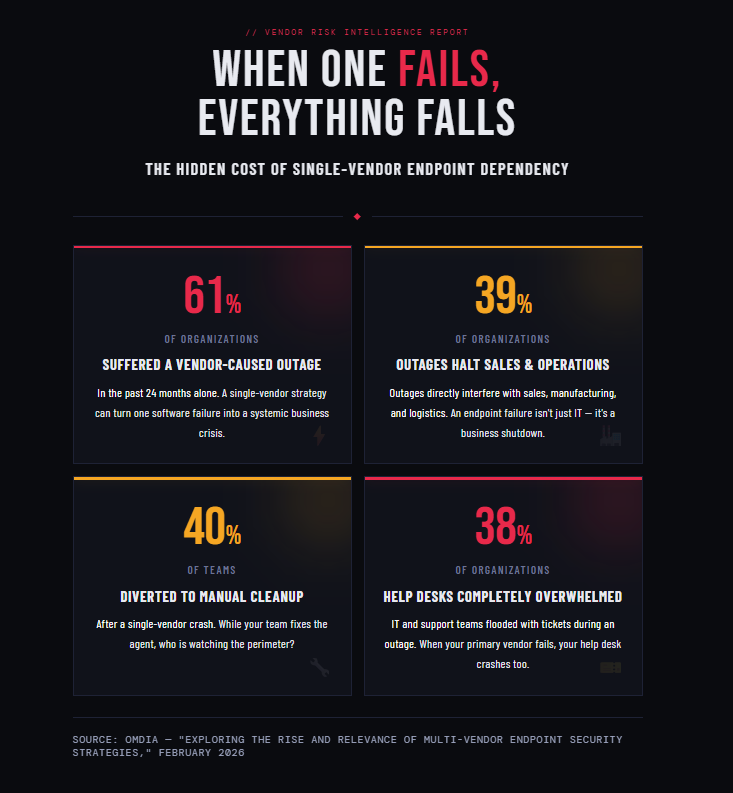
Single-vendor endpoint dependency creates systemic risk. The answer isn't more vendors — it's a smarter platform.
These aren't edge cases. They're the new normal for organizations running single-vendor endpoint strategies. Consider the ripple effects: critical systems become inaccessible, employee productivity plummets, revenue-generating operations cease, customer trust falters, and recovery costs multiply with each hour of downtime.
The Strategic Shift: Multi-Vendor EDR for Business Resilience
Forward-thinking organizations have recognized this vulnerability and are adopting a strategic response: implementing a multi-vendor EDR strategy. This involves deploying two distinct EDR solutions, strategically dividing coverage across critical systems to ensure continuous operations even when one solution experiences issues.
This isn't about lacking confidence in your primary security vendor, it's about acknowledging that technology failures happen, and your business continuity depends on having contingency plans in place. The Omdia research confirms this is now mainstream thinking: 85% of organizations are intentionally adding a secondary endpoint vendor to eliminate single points of failure and strengthen infrastructure resilience.
Key Benefits of a Multi-Vendor EDR Approach
Operational Continuity
Your business shouldn't stop because a security vendor does. When one EDR solution experiences an outage, update failure, or compatibility issue, a multi-vendor approach means other segments of your infrastructure stay protected and operational. Omdia found that 65% of organizations credit their multi-vendor strategy with giving IT and security teams the breathing room to diagnose and resolve incidents before a contained issue becomes a company-wide crisis.
Risk Distribution
Concentrating your entire endpoint security posture in a single vendor creates a dangerous dependency. One contract dispute, one failed update, one zero-day in the agent itself can leave your entire organization exposed simultaneously. Diversifying across multiple EDR solutions means no single vendor's vulnerability, business decision, or outage becomes your crisis. Just as financial portfolios spread risk across assets, your security stack should ensure that a failure in one solution never becomes a failure everywhere.
Enhanced Security Coverage
Different EDR solutions excel in different areas. By leveraging multiple vendors, you can capitalize on each solution's strengths while mitigating individual weaknesses.
Improved Vendor Accountability
When vendors know they're not your only security partner, they tend to be more responsive to your needs and more committed to maintaining high service levels.
Implementation Considerations
Organizations successfully deploying multi-vendor EDR strategies typically segment their endpoints in three primary ways, according to the Omdia research:
- Environment-based: The most common approach, segmenting by on-premises, cloud-based, and remote devices.
- OS and device type: Aligning vendors with specific operating systems or endpoint types (e.g., Windows vs. macOS vs. Linux).
- Risk and compliance profile: Over half of organizations segment based on risk profiles or specific regulatory requirements like HIPAA and PCI DSS.
Overcoming Common Concerns
"Won't this double our costs?"
While there are additional licensing costs, 92% of organizations report that the benefits of a multi-vendor strategy outpace any associated costs and challenges. Consider the alternative: the average annual cost of a vendor-caused outage is $1.89 million, rising to $2.2 million for organizations managing more than 5,000 endpoints. For most enterprises, the math strongly favors acting before an outage occurs.
"How do we manage two different consoles?"
Modern security operations centers already manage multiple tools. Notably, 54% of organizations find that running two EDRs actually makes rollouts safer by staggering updates across vendors, reducing the blast radius of any single bad update. The key is choosing solutions that integrate well with your existing security infrastructure and provide unified visibility where possible.
"Will this create security gaps?"
Properly implemented, a multi-vendor strategy actually reduces security gaps by eliminating single points of failure and providing diverse detection capabilities. The Omdia data reinforces this: organizations running integrated data models (feeding multiple endpoint solutions into a unified XDR or SIEM platform) report significantly fewer challenges with alert noise and coordinated response than those managing solutions in silos.
A Path Forward with Cortex XDR
For organizations looking to put this strategy into practice, the primary challenge identified in the Omdia research is complexity, and the antidote is choosing a secondary solution designed for integration, not just coexistence. That's where platform matters.
Cortex XDR is built for exactly this environment. Its lightweight agent minimizes system impact while delivering proven effectiveness, achieving 100% detection rates in recent MITRE ATT&CK evaluations with zero configuration changes required. And because Cortex XDR is part of the broader Palo Alto Networks platform, it brings multi-vendor endpoint data into a unified analytics layer. That centralized visibility is what turns a multi-vendor deployment from a management burden into a genuine force multiplier across the SOC.
The Bottom Line
The risk of endpoint security solution failure is real, well-documented, and worth mitigating with urgency. The organizations that recognize this are already building more resilient endpoint estates, and the data shows they're seeing positive ROI for it. A multi-vendor approach isn't a concession that your primary vendor will fail; it's a strategic acknowledgment that your business continuity is too important to rest on any single dependency.
The Omdia research puts it plainly: 93% of organizations anticipate increasing their endpoint security investment over the next 24 months. The question isn't whether the industry is moving in this direction, it's whether your organization will lead or follow.
Read the Full Research
The Omdia report "Exploring the Rise and Relevance of Multi-vendor Endpoint Security Strategies" (February 2026) surveyed 400 IT and security decision-makers across large enterprises in North America, Europe, and APAC. It provides a comprehensive look at how organizations are architecting resilient endpoint environments and the measurable business outcomes they're achieving.
Download the full Omdia report now.