Originally published March 27, 2026
Editor’s Note: This article was originally published by Koi Security on March 27, 2026. Following Koi Security’s acquisition by Palo Alto Networks, it has been republished to preserve historical research findings while providing additional context on software supply chain security. The research scope covers open-source extension security analysis conducted in February 2026.
Open VSX, the open-source extension marketplace behind development environments like Cursor, Windsurf, and the broader Visual Studio Code fork ecosystem, recently introduced a pre-publish scanning pipeline. Designed as an extensible verification gate, the system executes malware detection, secret scanning, binary analysis, and name-squatting checks before an extension goes live.
However, security analysis revealed a critical flaw in the pipeline’s error handling logic. The implementation relied on a single boolean return value that conflated "no scanners configured" with "all scanner jobs failed to enqueue." Under database resource contention, the system defaulted to treating failed enqueues as a benign absence of configured scanners. As a result, extensions submitted during peak traffic windows bypassed all security inspections while receiving an official status of PASSED.
Key Takeaways
- Fail-Open Error Logic: An ambiguous boolean return value in the scanner pipeline prevented calling services from distinguishing between an unconfigured scanner and an enqueue failure.
- Resource Exhaustion Exploitation: Concurrently flooding the publish API exhausted the database connection pool, causing scan job scheduling to fail silently and approve uninspected extensions.
- Zero-Permission Vector: The vulnerability required no administrative privileges—any user with a standard publisher account could trigger the flaw.
- Rapid Remediation: The Open VSX maintainers acknowledged the report and deployed a structural code fix within three days of disclosure.
The Pre-Publish Scanning Pipeline
To counter malicious software reaching open-source developer environments, the Open VSX platform established an automated pre-publish verification system (Issue #1331, PR #1529). The intended architecture requires every package to pass mandatory security checks prior to becoming downloadable by end users.
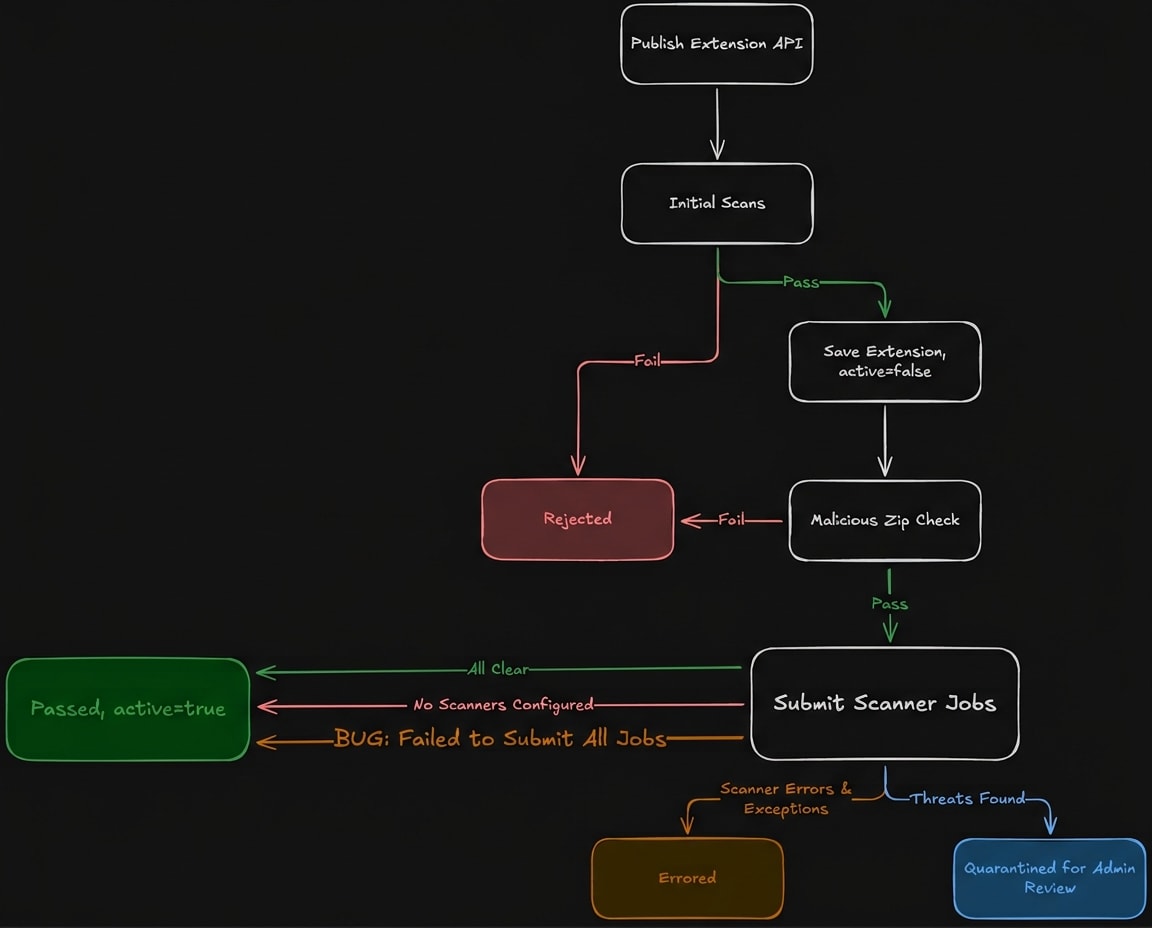
The execution flow consists of the following steps:
- Extension Submission: A publisher uploads a standard .vsix extension file via the marketplace API.
- Staging: The extension is saved to the backend store but remains inactive and hidden from download.
- Multi-Phase Scanning:
- Synchronous Checks: Inline validation rules test for immediate violations like name-squatting.
- Asynchronous Jobs: Deep inspection tasks (secret scanning, malware detection, binary analysis) are dispatched as parallel background tasks.
- Activation or Quarantine: A background service monitors scheduled jobs. If all scans return clean results, the extension is activated. If any engine flags a violation, the package is moved to quarantine for administrator evaluation.
- Watchdog Recovery: A background recovery worker periodically checks for stalled or failed jobs to re-enqueue them.
The Open Sesame Bug
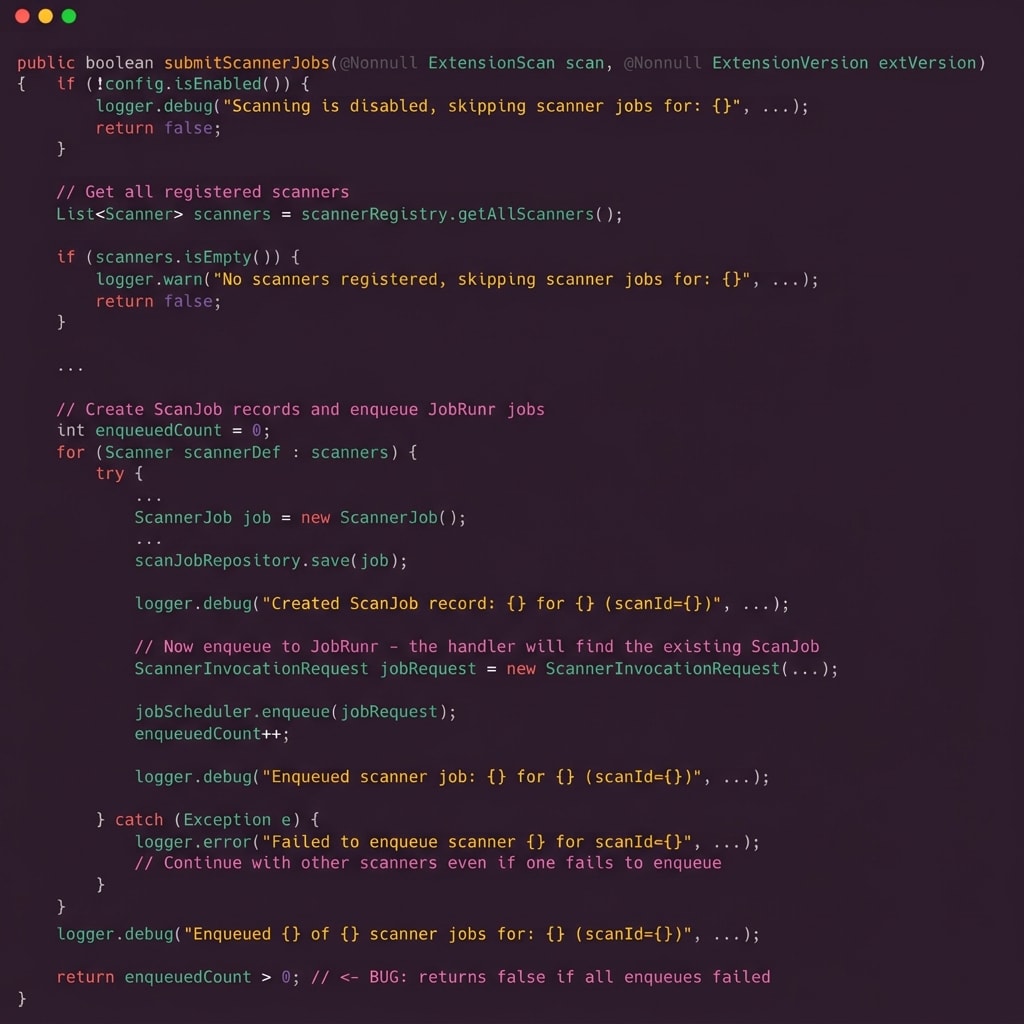
Let’s dive deeper into the bug and how it gained access to the software supply chain. The bug lives in how ExtensionScanService.java reports results, and how its caller interprets them. Let’s look into the scan submission method:
And here's the caller in PublishExtensionVersionHandler.java:
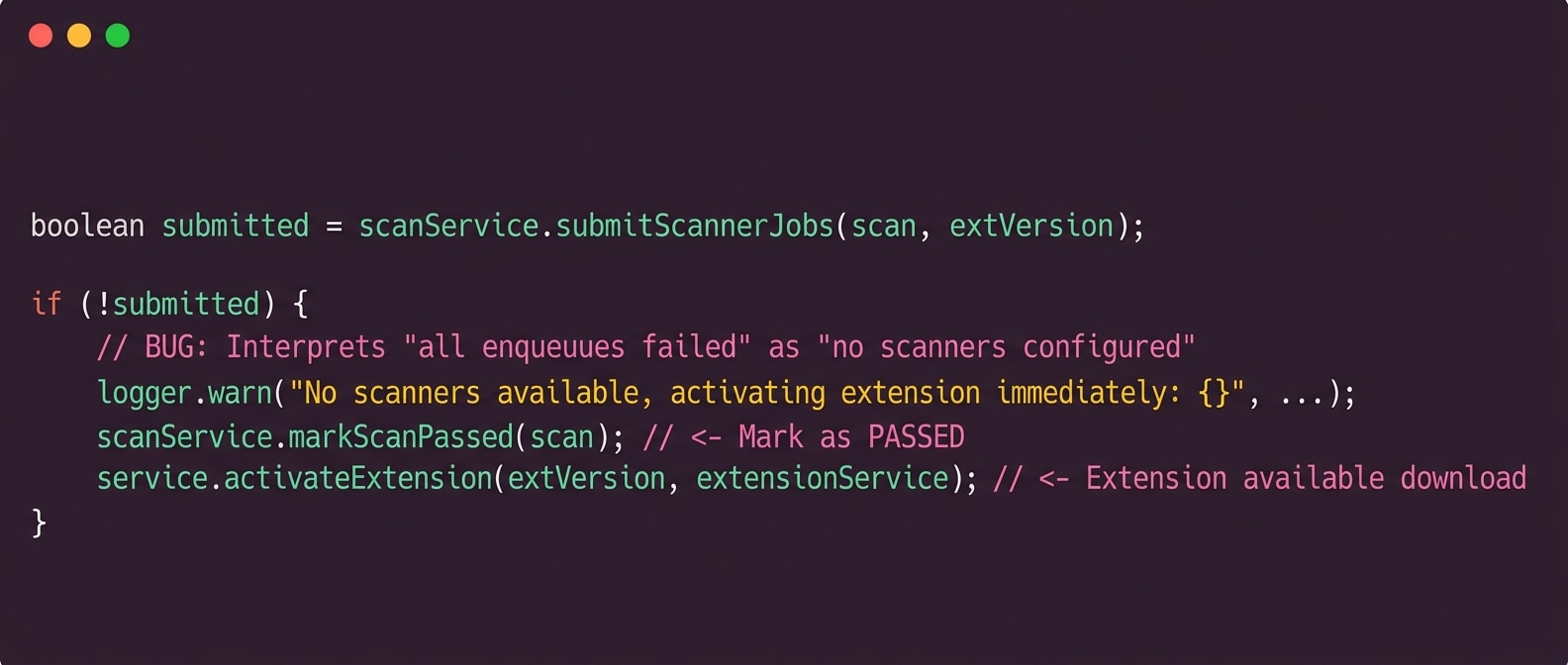
See the problem? That boolean conflates two completely different situations:
(A) No scanners are configured. A deliberate admin choice. Safe to activate.
(B) All scanner job enqueues failed. A transient error under load. NOT safe to activate.
When submitScannerJobs returns false, the caller assumes (A) every single time. Extension gets marked as passed, activated, made downloadable. But under load, that same false actually means (B). The scanners exist. They just couldn't be enqueued because the database connection pool is exhausted.
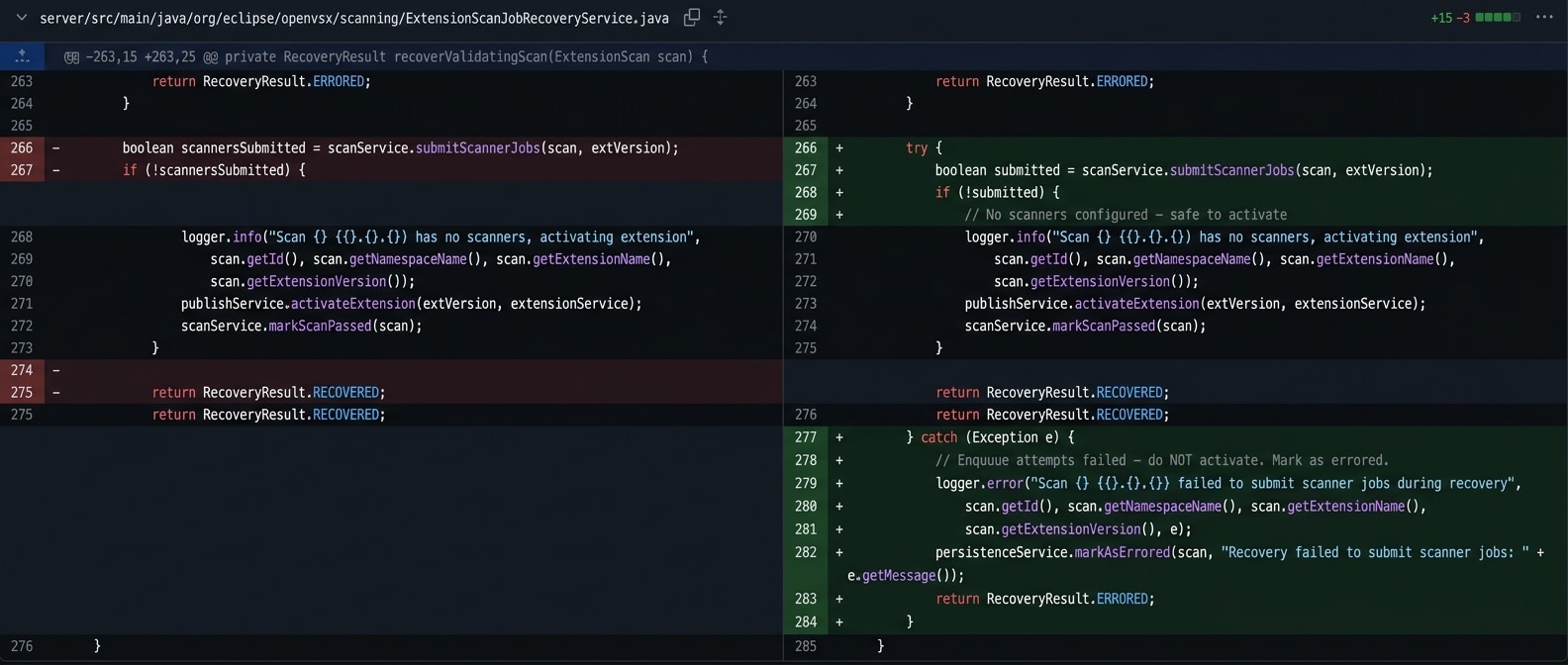
And it gets worse. The same pattern existed in ExtensionScanJobRecoveryService.java - the recovery path specifically designed to catch and retry failed scans. The safety net had the same hole as the system it was supposed to back up.
What Exploitation Looks Like
In this scenario, there are no special prerequisites - an attacker only needs a user! They prepare a batch of malicious extensions, each packaged as a standard .vsix file containing whatever payload they want, and flood the publish endpoint.
Here's why that works: each publish triggers the scanning pipeline, which needs to save ScanJob records and enqueue them to JobRunr. Both operations compete for database connections from the same shared pool. Under sufficient concurrent load, jobScheduler.enqueue() starts throwing exceptions. The catch block logs the error and moves on. Every scanner fails to enqueue. enqueuedCount stays at zero. The method returns false.
The gate opens. The extension goes live on open-vsx.org. Scan status: PASSED.
We confirmed this behavior in testing under controlled conditions, we were able to reliably trigger the fail-open path. The race window on any single attempt in production would be tight, but the attacker can retry indefinitely at zero cost with no rate limiting on the publish endpoint. It's a matter of when, not if.
The extensions that slip through are indistinguishable from any other extension on the marketplace. Nothing in the UI tells a developer that the extension skipped every security check. It looks exactly like it passed.
The Fix
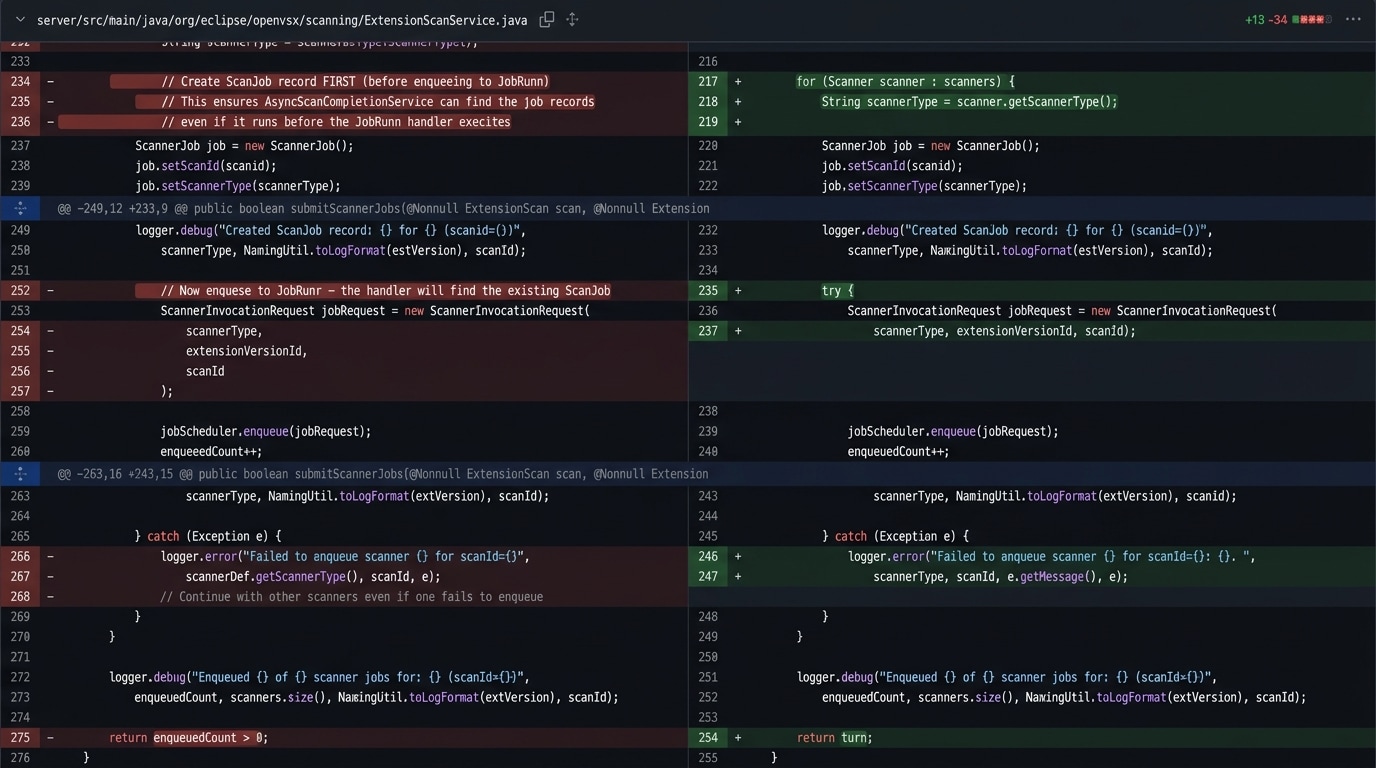
As always, the OpenVSX team did a great job closing this vulnerability, responded immediately and fixed it in a matter of 3 days.
The clean fix addresses the core ambiguity. No more ambiguous booleans. Failure means failure.
What You Should Do
Beyond this specific bug, it's worth thinking about what this pattern means more broadly. Pre-publish scanning is an important layer, but it's one layer. The pipeline's design is sound, but a single boolean that couldn't distinguish between "nothing to do" and "something went wrong" turned the entire infrastructure into a gate that opened under pressure. This is a common anti-pattern: fail-open error handling hiding behind a code path designed for a legitimate "nothing to do" case.
If you're building similar pipelines, make failure states explicit. Never let "no work needed" and "work failed" share a return value.
Organizations managing software supply chain risks across cloud environments and developer toolchains can leverage threat analysis and SecOps platformization to continuously monitor third-party integrations and posture. Learn more about proactive threat monitoring with Cortex® Agentic Endpoint Security.
Disclosure Timeline
| Date | Event |
|---|---|
| 2026-02-08 | Vulnerability discovered and reported to the Open VSX team. |
| 2026-02-11 | Open VSX team acknowledged the security disclosure. |
| 2026-02-11 | Fix committed and deployed (Commit 64720cc). |
Common Weakness Enumerations (CWE)
- CWE-636 (Not Failing Securely): The system approved extensions upon scanner failure rather than keeping them blocked.
- CWE-755 (Improper Handling of Exceptional Conditions): The connection exception was caught and logged without aborting or retrying the publish workflow safely.
- CWE-362 (Concurrent Execution with Improper Synchronization): Exploitation leveraged race conditions caused by resource contention.
- CWE-400 (Uncontrolled Resource Consumption): Absence of rate limiting allowed deliberate connection pool exhaustion.