NIST PQC Standards are a suite of formal cryptographic specifications developed by the National Institute of Standards and Technology to protect electronic information from future quantum computer attacks. These standards define specific algorithms, such as ML-KEM and ML-DSA, designed to replace current public-key encryption and digital signatures that are vulnerable to quantum-scale processing.
Key Points
Quantum Resistance: NIST PQC Standards utilize mathematical problems that remain computationally infeasible for both classical and quantum computers to solve.
Cryptographic Agility: Organizations must adopt flexible architectures that enable seamless transitions between legacy and post-quantum algorithms as standards evolve.
Algorithm Finalization: NIST has officially finalized three core standards—FIPS 203, FIPS 204, and FIPS 205—providing a stable foundation for global implementation.
Proactive Defense: Implementing these standards now mitigates "harvest now, decrypt later" risks, where adversaries capture encrypted data today to decrypt it once quantum hardware matures.
Protocol Integration: Migration requires updating foundational internet protocols, including TLS, SSH, and IPsec, to support larger PQC key sizes and signatures.
NIST PQC Standards Explained
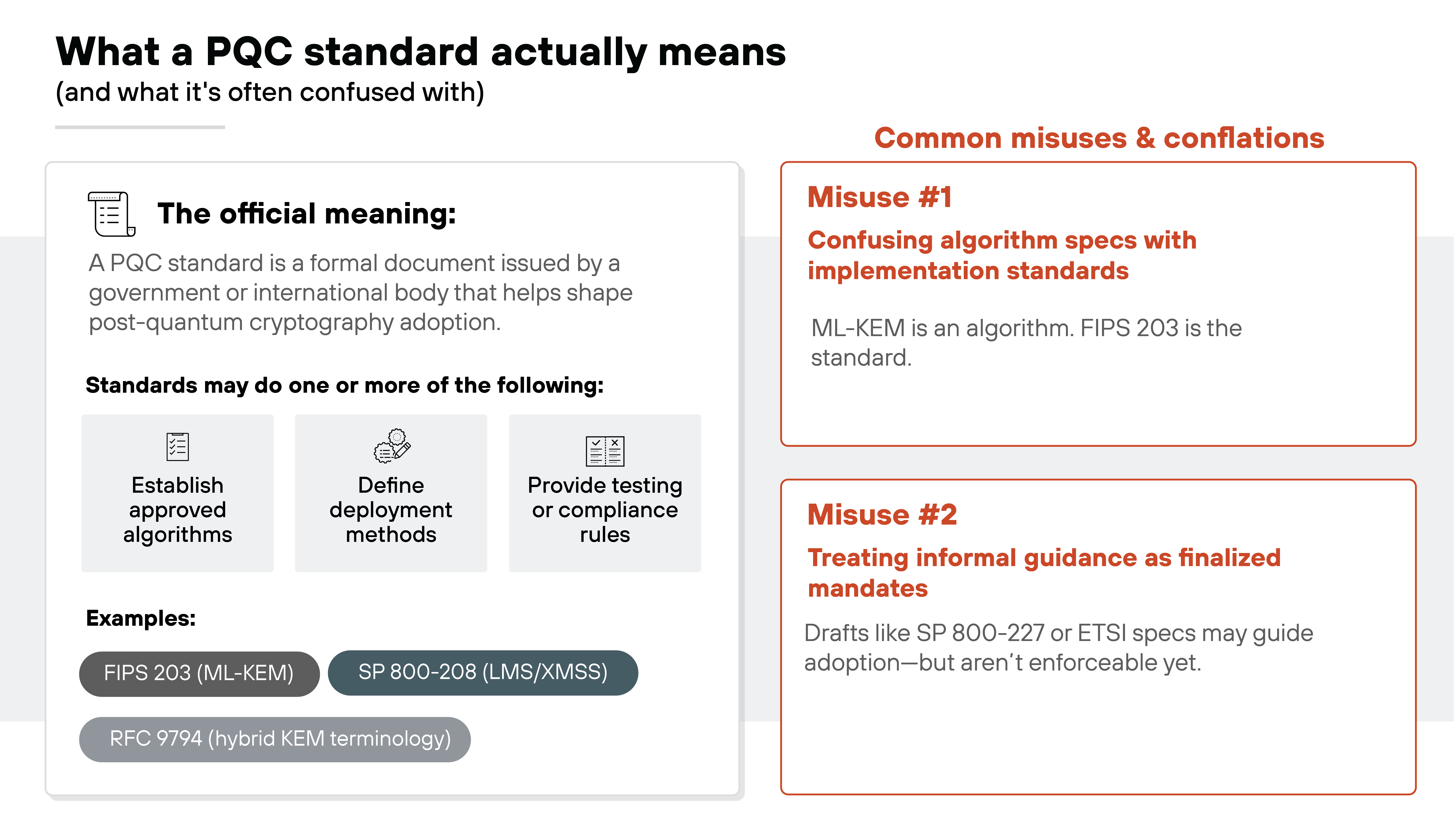
Figure 1: What a PQC standard means — and what it’s commonly mistaken for.
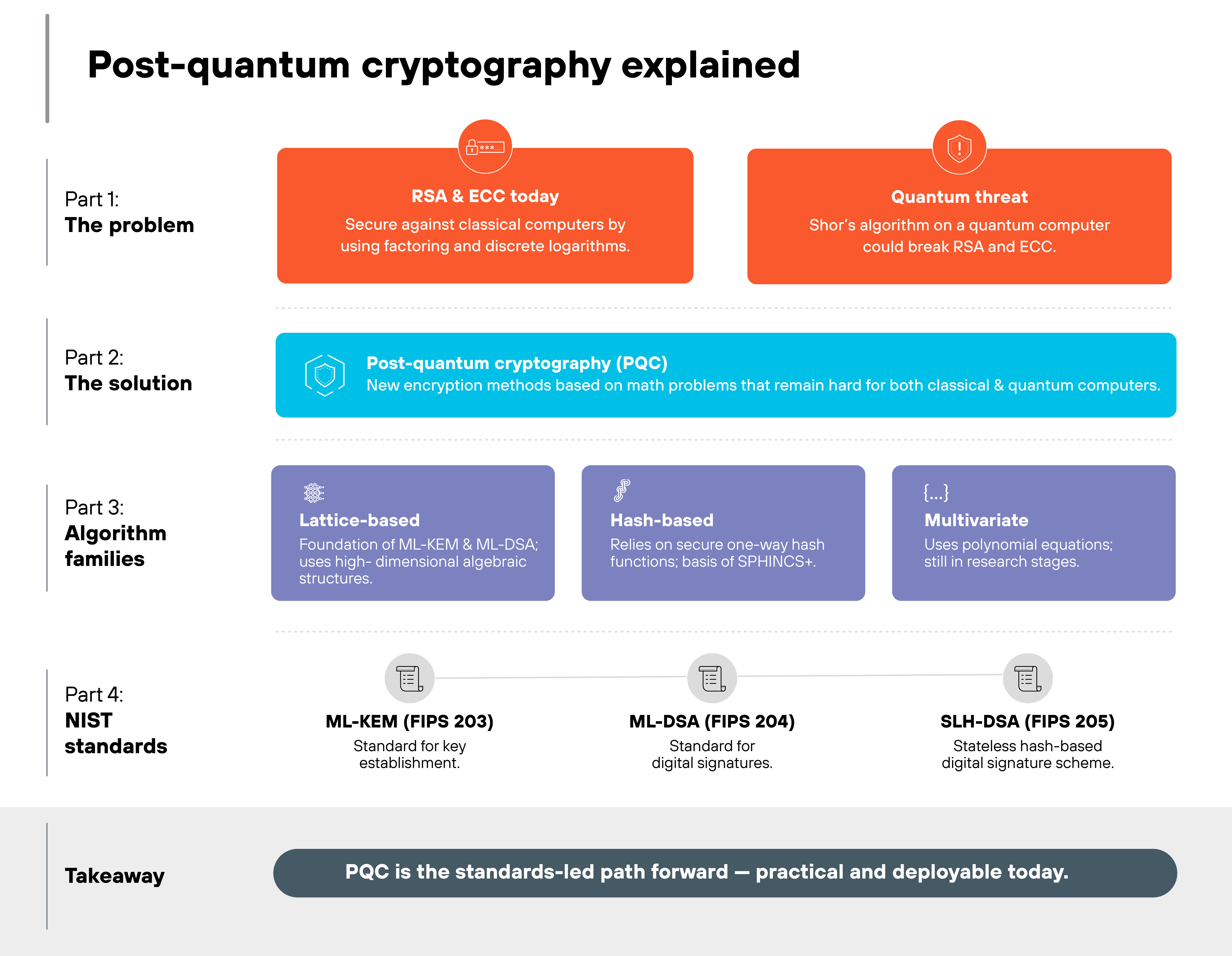
NIST PQC Standards represent a fundamental shift in the global cryptographic landscape, necessitated by the rapid advancement of quantum computing. Current asymmetric encryption methods, including RSA and Elliptic Curve Cryptography (ECC), rely on the difficulty of integer factorization and discrete logarithms. A cryptographically relevant quantum computer (CRQC) could utilize Shor’s algorithm to solve these problems in hours, effectively rendering existing digital security obsolete.
These standards provide the technical blueprints for implementing "quantum-safe" or "post-quantum" algorithms. By standardizing specific mathematical approaches, such as lattice-based cryptography, NIST ensures that hardware and software vendors can build interoperable, secure products. This standardization is critical for maintaining the integrity of global financial systems, government communications, and private data infrastructures.
For security leaders, these standards are not merely technical updates but a compliance and risk management mandate. Transitioning to NIST PQC Standards requires a comprehensive inventory of existing cryptographic assets and a phased migration strategy.
Because quantum-resistant algorithms often involve larger key sizes and different computational requirements, early testing is essential to avoid performance bottlenecks in production environments.
Figure 2: PQC vs. Quantum Cryptography: A comparison of math-based software solutions versus physics-based hardware requirements for quantum resilience.
The Urgency of Quantum-Resistant Cryptography
Modern encryption relies on the premise that classical computers cannot solve certain mathematical problems within a reasonable time frame. Quantum computers change this calculus by using qubits to perform massive parallel processing. While a full-scale quantum computer does not yet exist, the threat to data is immediate due to evolving adversary tactics.
Understanding the CRQC Timeline
A Cryptographically Relevant Quantum Computer (CRQC) is a theoretical machine with sufficient stability and qubit count to break current public-key standards. Estimates for the arrival of a CRQC range from the next decade to fifteen years. However, the National Security Agency (NSA) and other global bodies have already begun the transition process, signaling that the window for preparation is closing.
The Threat to RSA and ECC Protocols
Current standards like RSA, Diffie-Hellman, and Elliptic Curve Cryptography (ECC) are completely vulnerable to Shor’s algorithm. This vulnerability affects nearly every layer of digital interaction, from web browsing (HTTPS) to secure shell (SSH) access and virtual private networks (VPNs). If these protocols are not updated to NIST PQC Standards, the confidentiality and authenticity of all digital communications will be lost.
What Is the Timeline for PQC Adoption?
Post-Quantum Cryptography (PQC) adoption is no longer a theoretical concept; it is actively in progress.
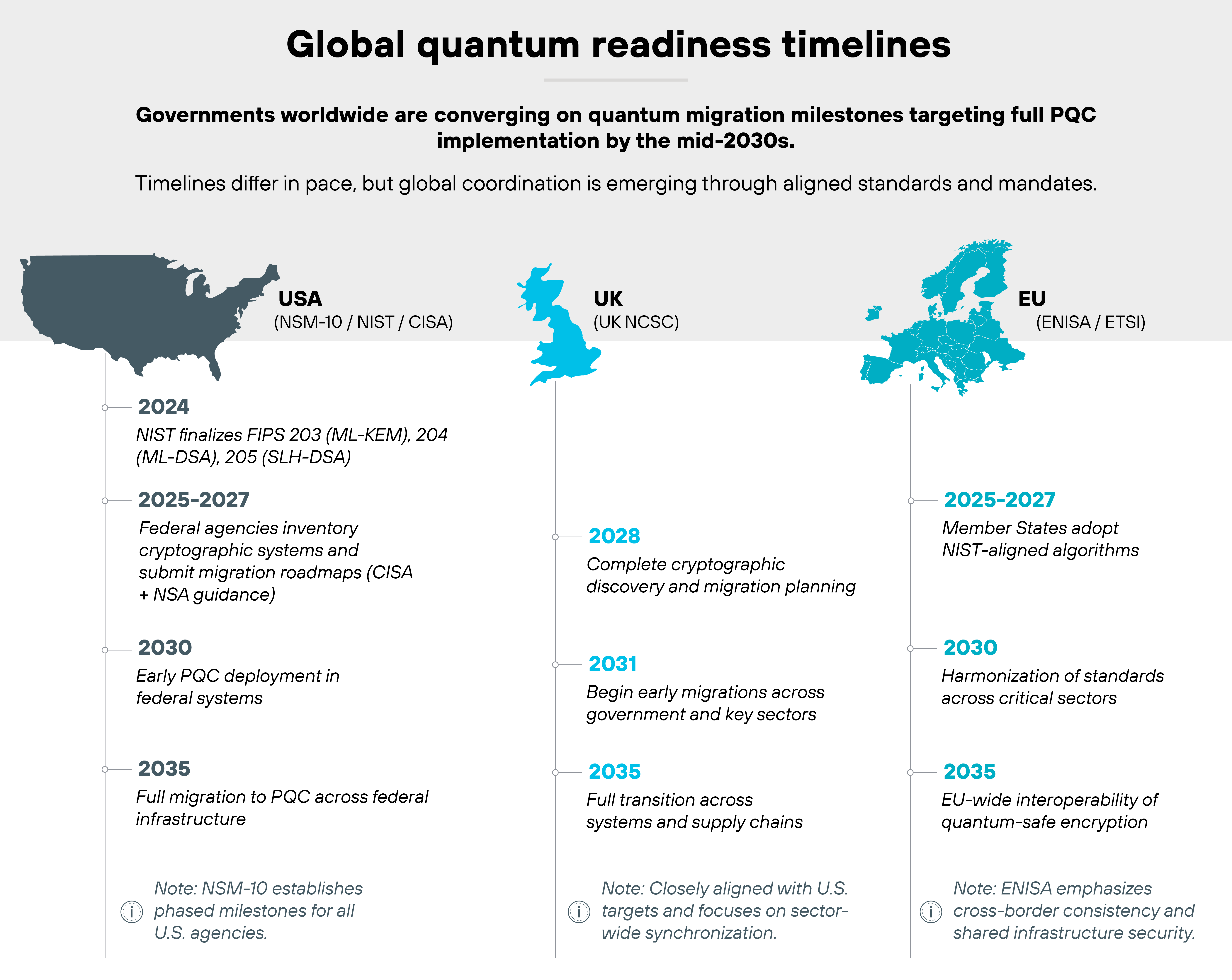
Compliance risk necessitates a clear understanding of the mandates and deadlines, both fixed and advisory. Standards, though essential, are only one element; the timelines are what create urgency. Knowing who is mandating what, and when, is crucial for staying ahead of compliance requirements.
PQC standardization and migration timeline
Milestone
Year
Who
First PQC algorithms selected for standardization
2022
NIST
First FIPS finalized (203–205)
2024
NIST
CNSA 2.0 migration begins
2025
NSA
Final NIST KEM recommendations (SP 800-227)
2025–2026
NIST
Hybrid TLS deployment expands
2025+
Global (IETF, vendors)
Recommended deprecation of classical PKC
2030
NIST, ASD
Classical algorithms disallowed in NSS
2035
CNSA 2.0
Global PQC Transition Deadlines and Recommendations
The global push toward PQC is accelerating, driven by distinct—but often converging—deadlines set by national and regional authorities.
United States (Most Rigid)
The U.S. has the strictest timeline:
CNSA 2.0 Deadline: A hard requirement mandates that purely post-quantum algorithms must be fully implemented in national security systems by 2035.
Current Action: Initial migration efforts are already in progress, specifically for key exchange and firmware signing.
Australia (Strict Recommendation)
Australia follows a similar, aggressive trajectory:
Recommendation: The ASD advises that all classical public-key cryptography should be eliminated by 2030.
Europe (Flexible but Moving)
Europe's approach is more flexible, though still targeting full PQC adoption:
Recommendation: ETSI encourages the adoption of hybrid algorithms now, with full PQC integration targeted by 2035.
Enforcement: Europe does not enforce the exact cutoff dates as rigidly as the U.S.
The Market Reality (Note)
Regardless of whether a timeline is labeled a "recommendation" or a "deadline," major technology vendors, including cloud providers, security platforms, and software and hardware companies that implement cryptography, typically treat these dates as hard mandates. This means most organizations will experience pressure to migrate well in advance of formal governmental enforcement.
NIST has moved beyond the evaluation phase and has formally finalized the first set of post-quantum standards. These documents serve as the authoritative guide for vendors and government agencies to begin high-level implementation.
Module-Lattice-Based Key-Encapsulation Mechanism (ML-KEM), formerly known as CRYSTALS-Kyber, is the primary NIST PQC standard for general-purpose key exchange. It allows two parties to establish a shared secret key over an insecure channel. ML-KEM is favored for its relatively high efficiency and smaller key sizes compared to other post-quantum candidates.
ML-DSA (FIPS 204): Digital Signature Standards
Module-Lattice-Based Digital Signature Algorithm (ML-DSA), derived from CRYSTALS-Dilithium, provides the framework for authenticating digital identities and verifying data integrity. This standard is intended to replace RSA and ECDSA signatures in certificates and secure handshakes.
Stateless Hash-Based Digital Signature Algorithm (SLH-DSA), based on SPHINCS+, offers a robust alternative that does not rely on lattice mathematics. While it features larger signature sizes and slower performance than ML-DSA, its reliance on well-understood hash functions makes it an excellent "fallback" security measure.
NIST PQC Algorithm Comparison
This table outlines the performance characteristics and resource requirements for the core finalized standards. Note that key and signature sizes are significantly larger than classical counterparts like RSA or ECC.
Algorithm
Standard
Primary Use Case
Public Key Size (Bytes)
Secret Key Size (Bytes)
Signature / Ciphertext Size (Bytes)
ML-KEM (Kyber)
FIPS 203
General-purpose key exchange and encryption.
800 – 1,568
1,632 – 3,168
768 – 1,568 (Ciphertext)
ML-DSA (Dilithium)
FIPS 204
General-purpose digital signatures for identity and data integrity.
1,312 – 2,592
2,528 – 4,896
2,420 – 4,595 (Signature)
SLH-DSA (SPHINCS+)
FIPS 205
Stateless fallback signature scheme; ideal for long-term security.
Post-quantum cryptography standards involve a full ecosystem. Different documents serve different roles: some define algorithms, others enable migration, and others shape protocol integration or validation pathways.
Understanding the current status and stage of each standard is essential for determining readiness and planning for compliant adoption. The following table shows how today's key PQC standards break down:
Note: Even if a standard is marked “final,” real-world implementation often depends on supporting guidance or protocol updates. That's why understanding the entire standardization landscape,not just the algorithms, is essential.
How Do Global PQC Standards and Policies Differ?
The priorities for these roadmaps differ, with some countries prioritizing speed while others emphasize flexibility, resilience, or maintaining local cryptographic independence. Consequently, global alignment on PQC standards is limited, resulting in implementation variations across different operating regions.
Grasping these distinctions is crucial, especially for organizations with cross-regional operations or those aiming to deploy standards-compliant cryptography globally. Below is an overview of the current PQC approaches taken by the major standards bodies:
Global Summary of PQC Algorithms and Policy Guidance
Country / Agency
Recommended / Accepted KEMs
Recommended / Accepted Signatures
Hybrid Policy
Special Notes
U.S. (NIST, CNSA 2.0)
ML-KEM-1024
ML-DSA-87, LMS/XMSS
Hybrid key establishment allowed during transition; long-term goal is pure CNSA 2.0 PQC for NSS.
Pure PQC required by 2035 for NSS.
UK (NCSC)
ML-KEM-768
ML-DSA-65, SLH-DSA, LMS/XMSS
Allowed as interim only.
Prefers pure PQC where feasible.
Germany (BSI)
ML-KEM-768/1024, FrodoKEM, McEliece
ML-DSA (3 & 5), SLH-DSA, LMS/XMSS
Recommended (except HBS).
Endorses multi-tree variants for long-term signatures.
France (ANSSI)
ML-KEM-768/1024, FrodoKEM
ML-DSA, SLH-DSA, FN-DSA, LMS/XMSS
Recommended.
Supports stateful and stateless hash-based signatures.
Netherlands (NLNCSA)
ML-KEM-1024, FrodoKEM, McEliece
ML-DSA, SLH-DSA, LMS/XMSS, HSS
Recommended.
Accepts wide range of hash-based and structured schemes.
Canada (CCCS)
ML-KEM
ML-DSA, SLH-DSA, LMS/HSS
Neutral.
No strong position on hybrid use.
Australia (ASD)
ML-KEM-768 (until 2029), ML-KEM-1024
ML-DSA-65 (until 2029), ML-DSA-87
Not recommended.
Favors pure PQC by 2030.
Korea
NTRU-HRSS, SMAUGT
HAETAE, AlMar
Not published.
National algorithm suite differs from NIST.
China
National PQC candidates under development
National PQC signature schemes under evaluation
Not publicly specified.
Continues domestic ECC (e.g., SM2) for classical crypto while developing separate PQC standards.
EU Commission
ML-KEM and others based on ETSI guidance
ML-DSA, SLH-DSA, LMS/XMSS
Recommended.
Encourages member states to adopt by 2030.
Key Differences in PQC Standards
Key Encapsulation: Most countries have accepted ML-KEM, establishing it as the baseline for international interoperability.
Digital Signatures: Preferences are more diverse. Some authorities favor stateless schemes like SLH-DSA, while others require stateful options such as LMS or XMSS, which necessitate careful state management to prevent key reuse.
Hybrid Cryptography: Policies differ regarding its use as a temporary measure. Some governments recommend or permit hybrid schemes, whereas others, like the U.S., discourage them in favor of fully post-quantum solutions.
Impact of Misaligned Standards
The lack of uniform standards increases the complexity of PQC adoption. Organizations must potentially support multiple algorithms, navigate different regional compliance requirements, and customize deployments based on the specific usage and location of cryptography.
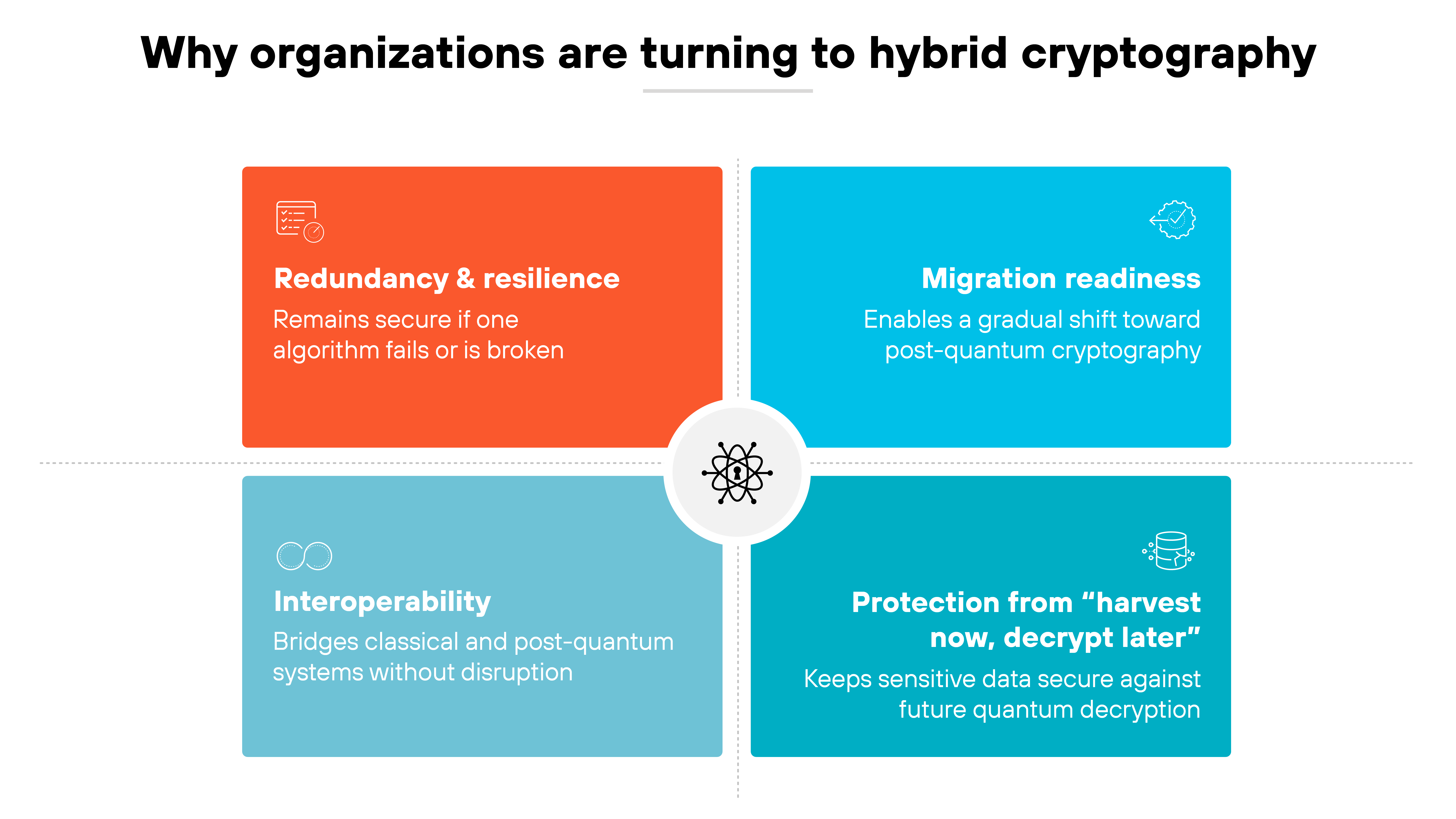
Hybrid cryptography is a key transitional tool for organizations migrating to a post-quantum environment. Since most organizations will not switch completely overnight, hybrid cryptography combines classical and post-quantum algorithms. This approach is designed for resilience: if one algorithm is compromised in the future, the other remains secure, thereby maintaining overall security during the migration period.
Regional policies on hybrid cryptography vary:
NIST currently permits hybrid key exchange (e.g., ML-KEM + X25519) but does not yet support hybrid signatures.
Other authorities, particularly in Europe, view hybrid adoption as a necessary interim step, with some even encouraging immediate hybrid TLS deployments.
The following table highlights the different regional approaches to hybrid cryptography adoption:
Regional Positions on Hybrid Cryptography
Region
Policy Stance
U.S. (CNSA 2.0)
Allowed for key exchange only; discouraged for signatures
UK (NCSC)
Permitted as interim for both KEM and signatures
EU (ETSI, EU Commission)
Recommended during migration
Germany (BSI)
Endorsed with caution
France (ANSSI)
Supports both hybrid KEM and signatures
Canada (CCCS)
Neutral stance
Australia (ASD)
Discourages hybrid long-term use
Hybrid crypto is a bridge, not a destination. The goal remains full PQC adoption, but in the meantime, it helps to reduce risk, preserve interoperability, and give implementers time to transition.
How NIST PQC Standards Differ from Classical Encryption
Transitioning to PQC is not a "drop-in" replacement because the mathematical structures of these new algorithms differ significantly from those used in the last 30 years.
Managing Increased Bandwidth and Latency
PQC algorithms generally require larger public keys and signature sizes. For example, an ML-KEM-768 public key is roughly 1,184 bytes, whereas a classical 256-bit ECC key is only 32 bytes. This increase can impact protocol handshakes, potentially leading to packet fragmentation in UDP-based protocols or increased latency in web page loads.
The Shift to Lattice-Based Mathematics
Most NIST-selected algorithms rely on "Learning with Errors" (LWE) problems within structured lattices. Unlike integer factorization, lattice problems are not known to be solvable by any existing quantum algorithm. This shift requires developers to implement new cryptographic libraries that are resistant to side-channel attacks specific to lattice operations.
Migrating to these standards requires a structured approach to avoid operational disruption. Organizations should view this as a long-term modernization project rather than a simple patch.
Step 1: Cryptographic Asset Inventory
Security teams must identify every instance of public-key cryptography within their environment. This includes checking TLS terminators, internal application code, hardware security modules (HSMs), and third-party SaaS integrations. You cannot secure what you have not mapped.
Step 2: Evaluating Crypto-Agility in Vendor Ecosystems
Crypto-agility is the ability of a system to switch cryptographic algorithms without requiring significant infrastructure changes. Organizations should prioritize vendors that demonstrate a roadmap for NIST PQC support and offer modular security architectures.
Step 3: Hybrid Deployment Strategies
A hybrid approach involves using both a classical algorithm (like X25519) and a post-quantum algorithm (like ML-KEM) in a single handshake. This ensures that the connection is secure as long as at least one of the algorithms remains unbroken. Many early adopters are using hybrid modes to gain quantum resistance while maintaining compliance with current FIPS 140-3 requirements.
Palo Alto Networks Unit 42 has observed that sophisticated threat actors are increasingly focused on data exfiltration of encrypted "high-value" information.
Exfiltration Velocity and Data Longevity
The "Harvest Now, Decrypt Later" (HNDL) strategy targets data with long-term sensitivity, such as government secrets, intellectual property, and long-lived financial records. Attackers are currently stockpiling this data, waiting for quantum hardware to catch up. For data that must remain secret for 10 or more years, the threat is not in the future; it is in the present.
Protecting Software Supply Chains from Quantum Risk
Attackers may also target software signing authorities to inject malicious code that appears legitimate. Transitioning to stateful hash-based signatures (NIST SP 800-208) for firmware and software updates is a critical defense against quantum-enabled supply chain attacks.
Overcoming PQC Implementation Challenges
The transition to PQC will face hurdles, particularly in resource-constrained environments like IoT devices or legacy industrial control systems.
Hardware Acceleration for PQC
The computational intensity of lattice-based mathematics may require hardware acceleration in high-throughput environments. Modern CPUs and specialized security chips are beginning to incorporate instructions optimized for PQC, which will be necessary to maintain performance at scale.
Standardizing Protocol Integration
Beyond the algorithms themselves, the IETF and other bodies are working to update protocols like TLS 1.3 and IKEv2 to handle PQC payloads. Organizations should monitor these developments to ensure their network equipment can support the updated standards without dropping connections due to "jumbo" handshake packets.
PQC Readiness: What to Do Now
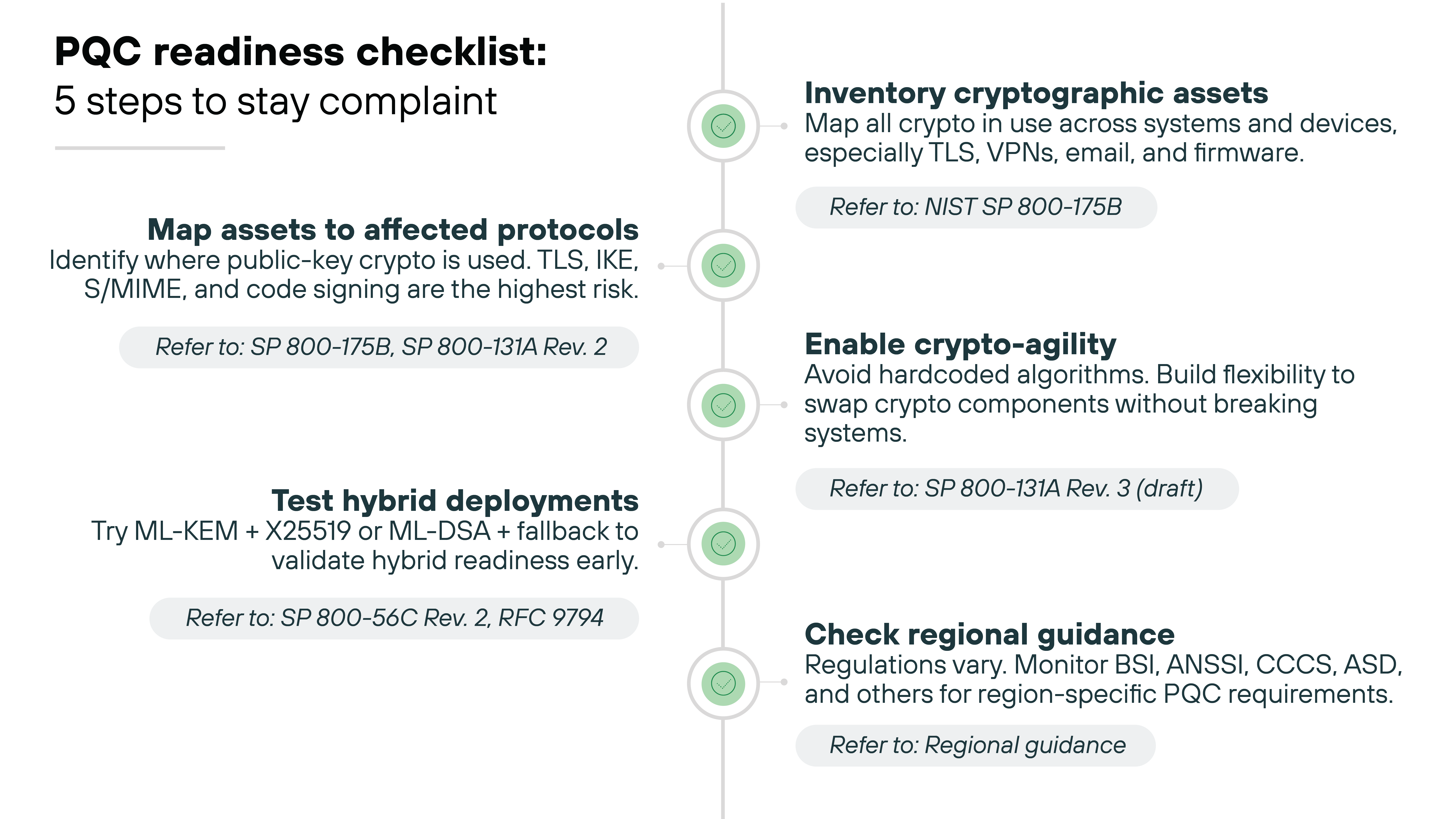
Figure 4: Five practical steps to prepare for post-quantum cryptography compliance.
Standards are finalized and timelines are published. Organizations need to act before migration bottlenecks, audit gaps, or vendor lag create risk exposure.
Here's what to prioritize now:
Inventory your cryptographic assets.
You can't replace what you haven't mapped. Start by identifying all systems, protocols, and libraries that use cryptography, especially in TLS endpoints, VPNs, email systems, and embedded firmware.
Refer to: NIST SP 800-175B
Map assets to affected protocols.
Focus on the protocols most at risk: TLS, IKE, S/MIME, and code signing. These depend on public-key cryptography, which quantum computers will break first.
Refer to: NIST SP 800-175B, SP 800-131A Rev. 2
Enable crypto-agility wherever possible.
Hardcoded algorithms will slow your migration. Design systems to support swapping cryptographic components without rewriting application logic.
Refer to: NIST SP 800-131A Rev. 3 (draft)
Start testing ML-KEM and ML-DSA in hybrid deployments.
Don't wait for production deadlines. Hybrid combinations like ML-KEM + X25519 or ML-DSA with fallback can help validate early compatibility.
Refer to: SP 800-56C Rev. 2, RFC 9794
Monitor your local authority's guidance.
Each country's path looks different. Check BSI, ANSSI, CCCS, ASD, and others for region-specific requirements that may go beyond NIST.
Refer to: Regional guidance (BSI, ANSSI, ASD, CCCS, etc.)
Staying compliant with PQC standards isn't just about paperwork. It's about building resilience before timelines harden and options disappear.
Q-Day refers to the theoretical point in time when a quantum computer becomes powerful enough to break current RSA and ECC encryption. Experts predict this could occur within the next 10 to 15 years, making current standardization efforts essential.
Waiting is risky because of the "Harvest Now, Decrypt Later" threat. Any data encrypted with classical methods today could be decrypted in the future. Additionally, large-scale cryptographic transitions historically take a decade or more to complete.
While NIST standards primarily govern federal agencies, they usually become de facto requirements for regulated industries like finance, healthcare, and critical infrastructure. Most security audits will eventually require NIST-compliant PQC for data protection.
No. PQC only secures the mathematical foundation of encryption. It does not protect against phishing, misconfigurations, or compromised credentials. PQC should be integrated into a broader Zero Trust architecture.
NIST recommends ML-KEM for general key exchange and ML-DSA for most digital signatures. However, specific use cases like firmware signing may require different standards, such as LMS or XMSS, which are already finalized under SP 800-208.