Quantum computing's risk to cybersecurity refers to the potential for cryptographically relevant quantum computers (CRQC) to break modern encryption standards. By utilizing Shor's algorithm, these systems can solve complex mathematical problems—such as prime number factorization—that underpin public-key infrastructure (PKI), rendering current digital protections for sensitive data and communications effectively obsolete.
Key Points
Quantum computing threatens public-key encryption: Future cryptographically relevant quantum computers could break widely used public-key algorithms such as RSA, Diffie-Hellman, and elliptic curve cryptography.
The risk starts before Q-Day: Attackers can steal encrypted data today and store it until quantum computers become powerful enough to decrypt it later.
The biggest risks go beyond encryption: Quantum computing can affect digital signatures, certificates, identity systems, secure boot, financial transactions, backups, IoT, and critical infrastructure.
Preparation starts with visibility: Organizations need a cryptographic inventory to understand where vulnerable algorithms, certificates, protocols, and keys are used.
Migration will take years: Moving to post-quantum cryptography requires planning, vendor coordination, testing, and crypto-agile systems that can support future algorithm changes.
What Are Quantum Computing Cybersecurity Risks?
Quantum computing cybersecurity risks are the security threats created when quantum computers become powerful enough to break or weaken the cryptographic systems that protect today’s data, identities, transactions, and communications.
Most modern digital security depends on encryption and digital signatures. These technologies protect web traffic, VPNs, certificates, software updates, cloud access, financial transactions, and sensitive records. A sufficiently powerful quantum computer could undermine many of these protections by solving mathematical problems that are currently impractical for classical computers.
The biggest concern is not that every encryption method will fail overnight. The concern is that many organizations depend on public-key cryptography in thousands of places they may not fully understand. If those systems are not discovered, prioritized, and migrated in time, quantum computing could create widespread security, compliance, operational, and trust failures.
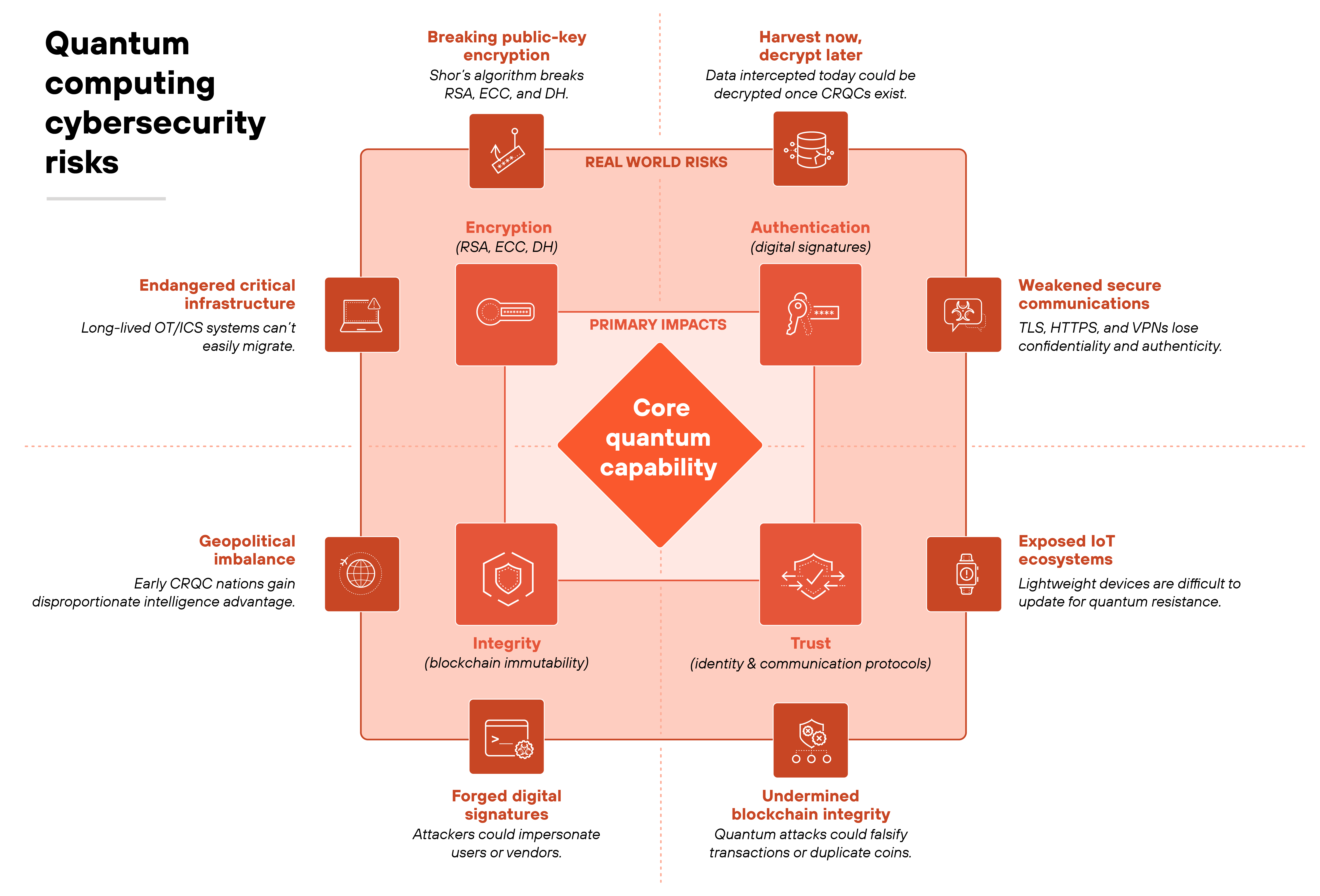
The eight major quantum computing cybersecurity risks are:
Risk
Why it Matters
How to Prepare
Breaking public-key encryption
RSA, Diffie-Hellman, and ECC could become vulnerable to quantum attacks.
Classical computers process information in bits. Quantum computers use qubits, which can represent and process information in ways that may allow certain calculations to happen much faster. This creates major opportunities for science, modeling, logistics, and computing — but it also creates a security problem.
Many public-key cryptographic systems rely on math problems that are extremely difficult for classical computers to solve. For example, RSA relies on the difficulty of factoring large numbers, while elliptic curve cryptography relies on the difficulty of solving elliptic curve discrete logarithm problems. A cryptographically relevant quantum computer could use quantum algorithms to solve these problems far more efficiently.
That means encryption that protects sensitive communications today may not be reliable in the future. It also means digital signatures used to prove identity, validate software, and authenticate transactions may eventually become easier to forge.
This does not mean every organization should panic or replace all cryptography immediately. It does mean organizations should start preparing now because cryptographic migration is complex, slow, and dependent on vendors, applications, protocols, certificates, hardware, and business-critical systems.
1. Breaking Public-Key Encryption
The most significant quantum cybersecurity risk is the potential failure of widely used public-key encryption. Public-key cryptography supports secure web browsing, VPNs, encrypted email, software updates, digital certificates, and many cloud and identity systems.
RSA, Diffie-Hellman, and elliptic curve cryptography are especially important because they help systems exchange keys, verify identities, and secure communications over untrusted networks. A cryptographically relevant quantum computer could weaken or break these algorithms, putting sensitive communications and authentication systems at risk.
Start by identifying where public-key cryptography is used across the organization. This includes TLS certificates, VPNs, APIs, applications, cloud services, identity providers, third-party platforms, and embedded systems. Once these dependencies are mapped, prioritize systems that protect high-value data, long-lived secrets, regulated information, or critical business functions.
Organizations should also begin planning for post-quantum cryptography, including NIST-standardized algorithms and hybrid approaches that combine classical and quantum-resistant cryptography during the transition period.
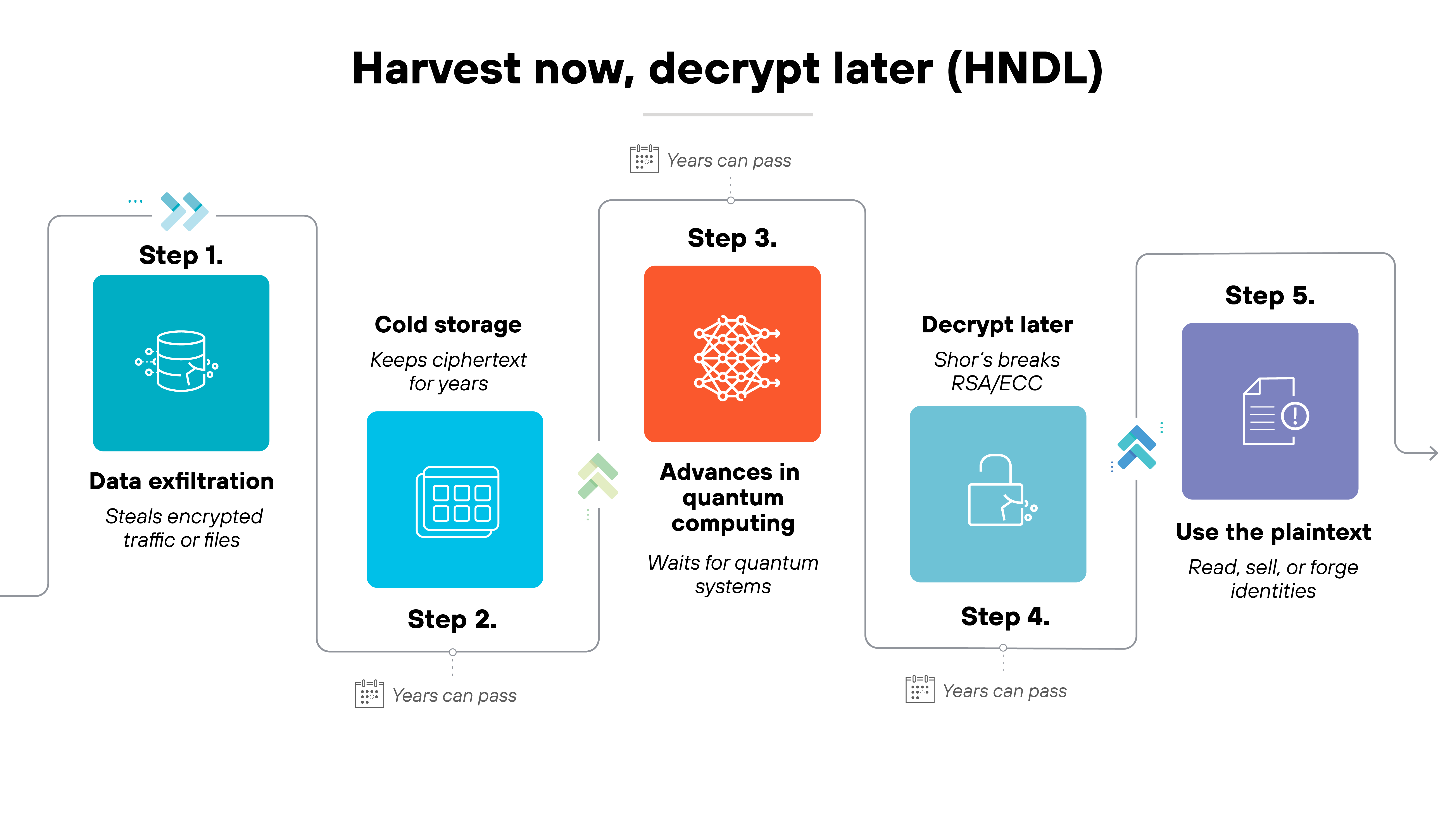
2. Harvest-Now, Decrypt-Later Attacks
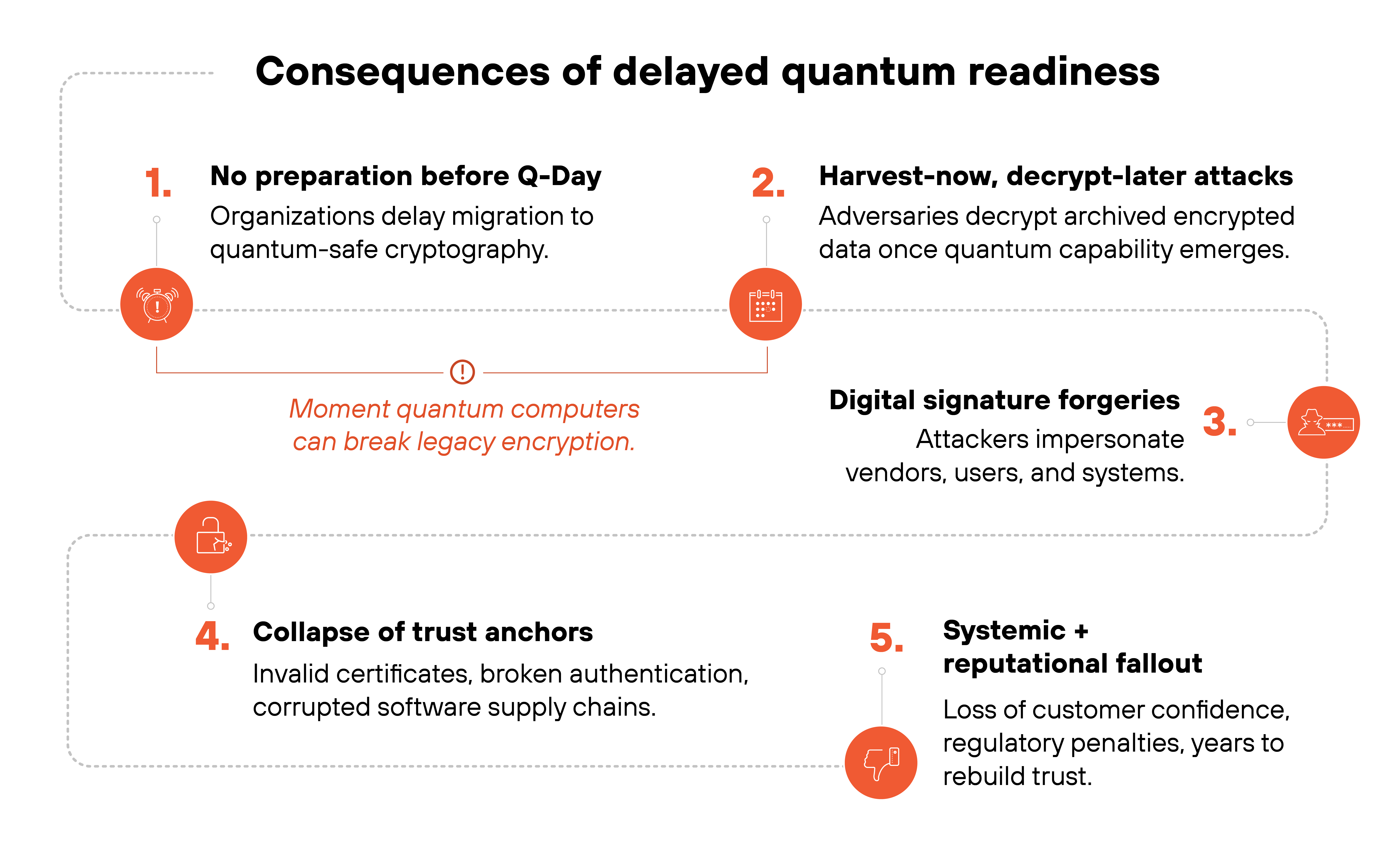
Harvest-now, decrypt-later attacks occur when adversaries steal encrypted data today and store it until quantum computers become powerful enough to decrypt it in the future.
This is one of the most urgent quantum risks because the attack does not require a quantum computer today. Attackers only need access to encrypted traffic, files, or backups that may remain valuable for years. Data with a long shelf life is especially exposed, including intellectual property, government information, healthcare data, legal records, source code, financial records, merger and acquisition data, and sensitive communications.
For organizations with long data-retention periods, the breach timeline changes. Data stolen now may not become readable immediately, but it may still become a future liability.
How to Reduce This Risk
Identify data that must remain confidential for years or decades. Prioritize encryption upgrades for systems that store or transmit long-lived sensitive information. Review data retention policies, backup storage, data loss prevention controls, and monitoring for unusual data exfiltration.
Organizations should also evaluate where encrypted data may be exposed in transit, including VPNs, web applications, APIs, remote access tools, and third-party integrations.
3. Forgery of Digital Signatures
Digital signatures prove that software, documents, certificates, transactions, or messages came from a trusted source and were not modified. They are used across software supply chains, certificate authorities, financial systems, identity systems, firmware, and secure communications.
If quantum computers can derive private keys from exposed public keys, attackers could forge digital signatures. That could allow malicious software updates to appear legitimate, fraudulent transactions to look authorized, or fake certificates to be trusted by browsers and applications.
This risk is especially serious because digital signatures are not only about confidentiality. They are about trust. Once trust systems fail, organizations may struggle to determine what is authentic and what has been tampered with.
How to Reduce this Risk
Map where digital signatures are used across the enterprise. Include code signing, certificate authorities, software updates, device authentication, financial workflows, document signing, and identity federation.
Prioritize signing systems that protect software supply chains, privileged access, critical infrastructure, and high-value transactions. Plan migration to quantum-resistant digital signature schemes as standards, vendor support, and operational readiness mature.
Get your quantum readiness assessment
The assessment includes:
Overview of your cryptographic landscape
Quantum-safe deployment recommendations
Guidance for securing legacy apps & infrastructure
Secure boot helps ensure that devices only run trusted firmware and operating system components. It relies on cryptographic checks that validate code before a system starts.
If the signatures or cryptographic roots used in secure boot become vulnerable, attackers may be able to bypass trust checks and load malicious firmware or boot-level code. This type of compromise is especially dangerous because it can occur before traditional security tools are active.
Secure boot risk matters for laptops, servers, network devices, industrial systems, medical devices, IoT devices, and other hardware that may remain in service for many years.
How to Reduce this Risk
Identify systems that rely on secure boot, firmware validation, or hardware roots of trust. Determine which cryptographic algorithms and signing processes support those trust chains.
Organizations should work with hardware, firmware, and device vendors to understand post-quantum support roadmaps. For systems that cannot be upgraded, consider segmentation, compensating controls, accelerated replacement, or tighter monitoring.
5. Vulnerability of Financial Transactions and Ledgers
Financial systems rely heavily on cryptography to authorize transactions, protect account access, validate records, and secure communications between institutions, customers, and service providers.
Quantum computing could affect payment systems, trading platforms, blockchain-based systems, digital wallets, and other transaction environments that depend on public-key cryptography and digital signatures. If attackers can forge signatures or compromise cryptographic proofs of ownership, they may be able to authorize fraudulent activity or undermine trust in digital records.
The risk is not limited to cryptocurrency. Traditional financial systems also depend on certificates, encrypted connections, identity validation, and trusted transaction workflows.
How to Reduce this Risk
Review the cryptographic dependencies used in payment processing, transaction authorization, customer authentication, APIs, ledgers, settlement systems, and third-party financial integrations.
Prioritize systems where cryptographic failure could create fraud, regulatory exposure, operational disruption, or reputational damage. Financial organizations should also coordinate migration plans with vendors, payment networks, cloud providers, and industry standards bodies.
6. Decryption of Historical Data Backups
Many organizations store encrypted backups for years to meet business, legal, regulatory, or operational requirements. These archives may contain emails, customer records, employee data, intellectual property, incident records, contracts, financial documents, and sensitive communications.
If backups are encrypted with quantum-vulnerable methods, they may become readable in the future. This creates a long-tail exposure problem: even if production systems are upgraded, older archives may remain vulnerable.
Historical backups are attractive targets because they often contain large volumes of sensitive data and may not receive the same level of monitoring as active systems.
How to Reduce this Risk
Review backup encryption, retention periods, access controls, and storage locations. Identify archives that contain long-lived sensitive data and determine which cryptographic methods protect them.
For high-risk archives, consider re-encryption, shorter retention periods, stronger access controls, data minimization, and monitoring for unauthorized access or bulk transfer activity.
7. Identity and Access Management Failure
Identity and access management systems depend on cryptography to verify users, devices, services, tokens, certificates, and sessions. If the cryptographic foundations of IAM weaken, attackers may be able to impersonate trusted identities or bypass authentication workflows.
This risk affects certificate-based authentication, single sign-on, privileged access, API authentication, device trust, hardware security keys, and service-to-service communication. Quantum-enabled identity compromise could be especially damaging because it may look like legitimate access rather than a conventional intrusion.
How to Reduce This Risk
Inventory certificates, tokens, keys, authentication protocols, and identity providers. Identify where RSA, ECC, or other quantum-vulnerable algorithms are used.
Prioritize privileged accounts, administrative access, cloud control planes, machine identities, service accounts, and identity systems connected to critical business applications. Build crypto-agility into identity infrastructure so certificates, keys, and algorithms can be updated without major disruption.
8. Obsolescence of Legacy IoT and Embedded Systems
IoT, operational technology, medical devices, industrial control systems, and embedded devices often have long lifecycles and limited update capabilities. Some use hardcoded cryptography, outdated libraries, or hardware that cannot support newer cryptographic requirements.
This creates a serious quantum-readiness problem. Even if enterprise applications and cloud systems migrate to post-quantum cryptography, legacy devices may remain vulnerable for years.
These systems are especially risky in healthcare, manufacturing, utilities, transportation, energy, and critical infrastructure environments, where replacement cycles can be slow and downtime can be expensive.
How to Reduce this Risk
Identify IoT, OT, embedded, and unmanaged devices that rely on cryptography. Determine whether vendors support firmware updates, certificate changes, and future post-quantum requirements.
For systems that cannot be updated, use segmentation, access controls, monitoring, replacement planning, and compensating controls. Build quantum-readiness requirements into future procurement and vendor evaluation processes.
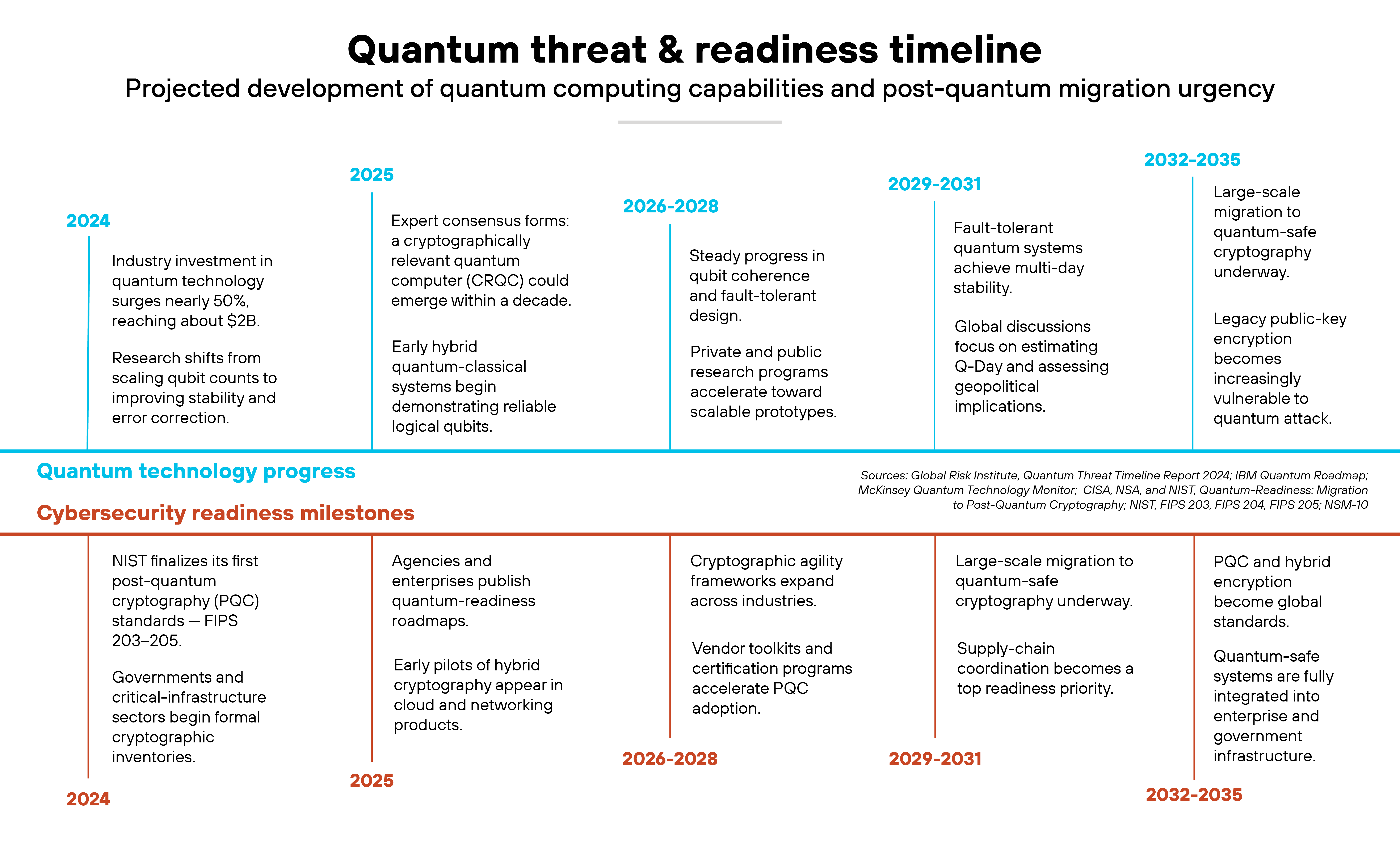
The exact arrival date of a cryptographically relevant quantum computer is uncertain. Today’s quantum computers are not yet capable of breaking RSA or elliptic curve cryptography at enterprise scale. However, the preparation timeline matters more than the prediction timeline.
Post-quantum migration can take years because cryptography is embedded across applications, infrastructure, vendors, certificates, protocols, devices, and business workflows.
Organizations that wait until quantum computers are fully capable may not have enough time to discover vulnerable systems, test replacements, coordinate vendors, and deploy quantum-safe protections.
Quantum-capable attacks against public-key cryptography are not yet available at scale, but sensitive data is already at risk from harvest-now, decrypt-later activity.
Identify long-lived sensitive data and begin cryptographic discovery.
Standards adoption
NIST-standardized post-quantum algorithms provide a path toward quantum-resistant cryptography.
Evaluate vendor support and begin planning migration.
Transition period
Organizations test PQC and hybrid cryptography across applications, certificates, identity systems, and network protocols.
Prioritize high-risk systems and pilot migration.
Broad migration
PQC support becomes more common across products, platforms, and protocols.
Replace or update vulnerable algorithms.
Long-term crypto-agility
Cryptographic standards continue to evolve.
Build systems that can change algorithms without major redesign.
The goal is not to predict Q-Day perfectly. The goal is to avoid being unprepared when the risk becomes operationally urgent.
How Organizations Can Prepare For Quantum Cybersecurity Risks
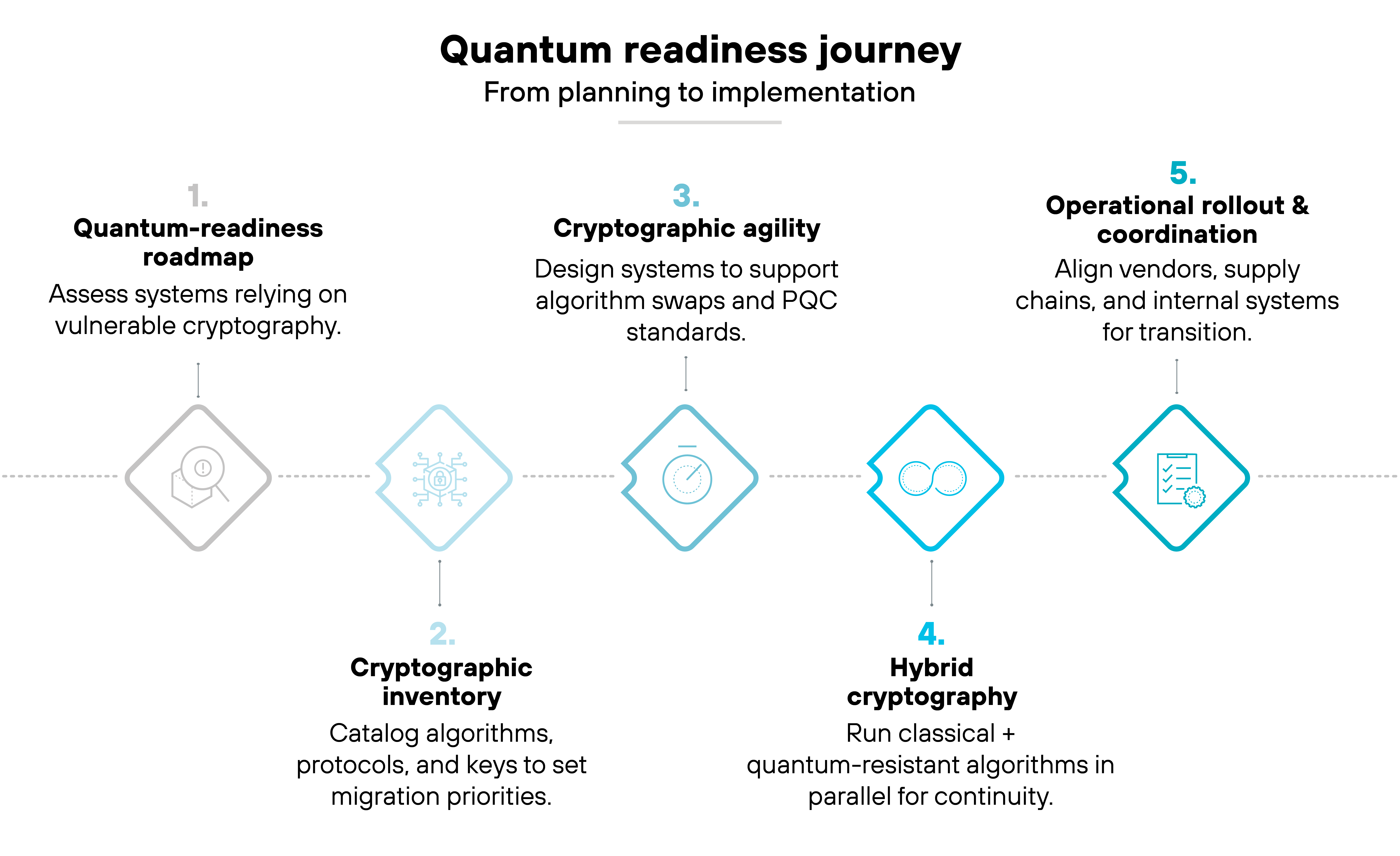
Quantum readiness should be treated as a phased security modernization effort. It is not a single encryption swap. It requires visibility, governance, prioritization, testing, migration, and ongoing crypto-agility.
1. Build A Quantum-Readiness Roadmap
Define ownership, scope, milestones, and decision points. A roadmap should identify which teams are responsible for cryptographic discovery, risk assessment, vendor coordination, migration planning, and executive reporting.
The roadmap should also clarify which systems and data types are most important to protect first.
2. Create A Cryptographic Inventory
A cryptographic inventory documents where cryptography is used across the organization. It should include algorithms, keys, certificates, protocols, libraries, applications, APIs, devices, vendors, and cloud services.
This inventory is the foundation of quantum readiness. Without it, organizations cannot reliably determine which systems are vulnerable or which migrations should happen first.
3. Identify High-Risk Data And Systems
Not every system has the same level of quantum exposure. Prioritize systems based on:
Sensitivity of the data
Length of time the data must remain confidential
Business criticality
Regulatory requirements
External exposure
Vendor dependency
Migration complexity
Use of public-key cryptography
Impact of authentication or signature failure
Systems protecting long-lived sensitive data should move higher on the list.
4. Engage Vendors Early
Many organizations rely on third-party products, cloud services, SaaS platforms, hardware, certificates, and managed services. Quantum readiness depends on those vendors’ ability to support post-quantum algorithms and hybrid migration models.
Ask vendors about their post-quantum roadmap, standards support, testing timelines, certificate support, APIs, firmware updates, and migration guidance.
5. Pilot Post-Quantum And Hybrid Cryptography
Organizations should test PQC and hybrid approaches in controlled environments before broad deployment. Early pilots can uncover performance, compatibility, certificate, application, and operational issues.
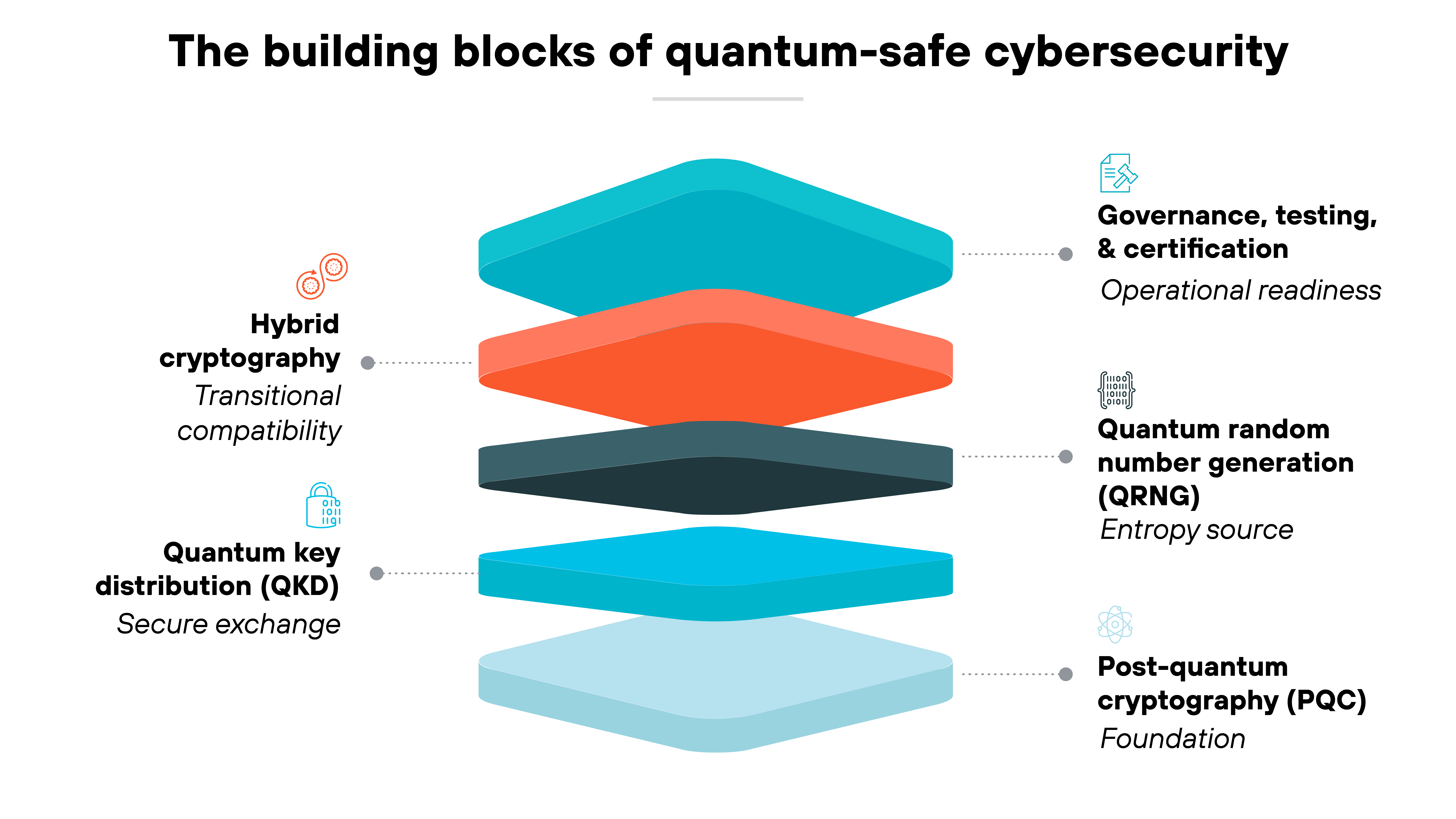
Hybrid cryptography can help organizations transition by combining classical and quantum-resistant algorithms during the migration period.
6. Build Crypto-Agility
Crypto-agility is the ability to change cryptographic algorithms, libraries, keys, and protocols without major system redesign. This matters because post-quantum standards, implementation guidance, and vendor support will continue to evolve.
Crypto-agile systems make future migrations faster, safer, and less disruptive.
7. Monitor, Validate, And Update
Quantum readiness is not a one-time project. Organizations should monitor changes in standards, vendor capabilities, regulatory expectations, cryptographic vulnerabilities, and threat activity.
Security teams should also validate whether cryptographic updates are actually deployed, properly configured, and working as intended.
Quantum Computing Cybersecurity Risk Examples
Scenario
Quantum risk
Business impact
Encrypted traffic is captured today
Data may be decrypted later by quantum-capable attackers.
Exposure of confidential communications, trade secrets, or regulated data.
A legacy VPN uses vulnerable key exchange
Remote access could become insecure.
Increased risk of unauthorized access.
Code signing relies on vulnerable signatures
Attackers may forge trusted software updates.
Software supply chain compromise.
Certificate infrastructure cannot support PQC
Authentication systems may lag behind security standards.
Operational disruption and trust failures.
Sensitive archives use quantum-vulnerable encryption
Long-term records may become readable.
Legal, regulatory, and reputational damage.
IoT devices cannot be updated
Devices may remain permanently quantum-vulnerable.
Persistent exposure in critical environments.
Identity systems depend on vulnerable certificates
Attackers may impersonate users, devices, or services.
Privilege escalation and cloud compromise.
What changed recently in post-quantum cybersecurity?
Digital signatures for authentication and integrity.
FIPS 205
Stateless hash-based digital signatures.
The standards do not mean every organization can migrate instantly. Products, protocols, certificates, vendors, and operational processes still need time to mature. But they do give security teams a practical foundation for planning, testing, and prioritizing post-quantum migration.
Quantum Computing Cybersecurity Risks FAQs
The biggest cybersecurity risk from quantum computing is the potential to break widely used public-key cryptography, including RSA, Diffie-Hellman, and elliptic curve cryptography. These algorithms help secure web traffic, VPNs, certificates, digital signatures, software updates, and identity systems.
Yes, but the risk is partly present-day and partly future-facing. Quantum computers are not currently breaking enterprise encryption at scale, but attackers can steal encrypted data now and store it for future decryption. This is known as harvest-now, decrypt-later risk.
Q-Day is the point at which a quantum computer becomes powerful enough to break commonly used public-key cryptography. The exact date is uncertain, but organizations should prepare before Q-Day because cryptographic migration can take years.
Symmetric encryption such as AES is generally more resilient against quantum attacks than public-key cryptography. AES-256 is commonly viewed as a stronger option for protecting data against future quantum-enabled brute-force risk. However, organizations still need to evaluate key management, implementation, protocols, and the broader systems that use encryption.
The first step is to create a cryptographic inventory. Organizations need to know where cryptography is used before they can determine which systems are vulnerable, which data is most exposed, and which migrations should happen first.
Post-quantum cryptography uses algorithms designed to resist attacks from both classical and quantum computers. It helps organizations replace vulnerable public-key algorithms with quantum-resistant alternatives for key establishment, digital signatures, and secure communications.
Crypto-agility is the ability to change cryptographic algorithms, keys, certificates, and protocols without rebuilding major systems. It helps organizations adapt as standards, threats, and vendor capabilities evolve.
Organizations should prioritize systems that protect long-lived sensitive data, critical infrastructure, privileged access, financial transactions, regulated information, software supply chains, and high-value communications. Systems with high business impact or difficult migration paths should also be assessed early.